The Two Big Issues the Housing Market’s Facing Right Now
The biggest challenge the housing market’s facing is how few homes there are for sale. Mark Fleming, Chief Economist at First American, explains the root causes of today’s low supply:
Open up a home search and you'll see them. Listings that have been on the market for two months. Three. Some longer.
Most buyers scroll right past them, assuming something’s wrong with the house. But that instinct could be costing you, since the longer a home sits, the more motivated the seller usually gets.
If affordability has been your #1 hurdle to buying, here’s a surprisingly simple strategy that could help you finally get your foot in the door. Start with the homes that have been sitting the longest. That’s often where the best deals are.
Here’s why. Data from Realtor.com shows there’s a connection between longer time on the market and lower sales prices. Basically, the longer a house sits, the more likely it is that the seller will reduce the price (see graph below):
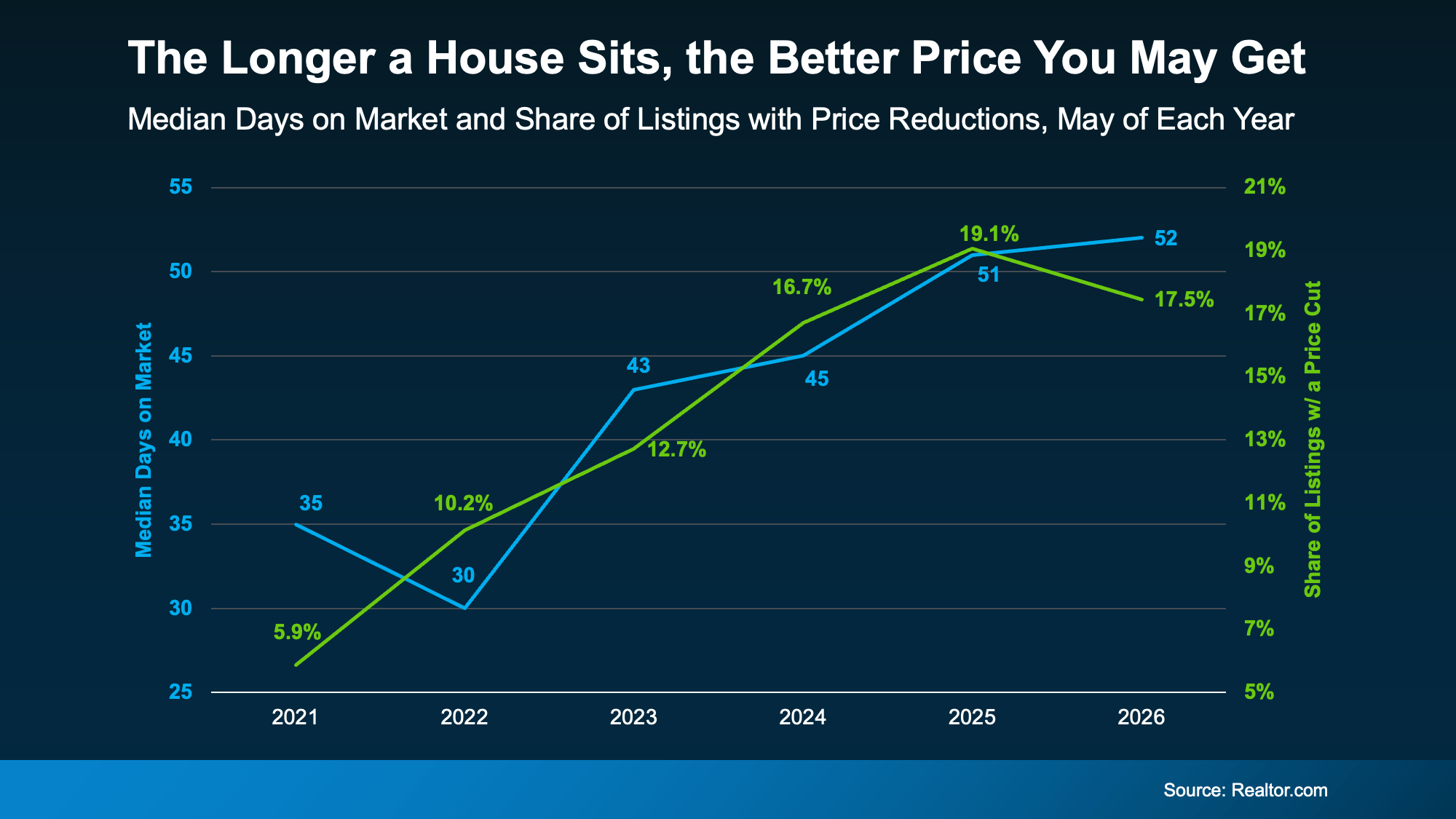
The blue line tracks how long homes stay on the market, while the green line tracks the share of homes getting a price reduction. As one climbs, so does the other.
And if you focus on these homes that are just sitting and waiting, the opportunity for you is bigger than you may think right now.
Redfin data shows there’s $347 billion worth of stale listings on the market right now – more than ever before for this time of year. So, ask your agent to filter listings for you from oldest to newest. The home that fits your budget might already be there. Just further down the list than you thought.
Let’s say you do that and something catches your eye. Still, you might be questioning why the home has been sitting in the first place. Just remember, sometimes it has nothing to do with the home itself.
According to Redfin, common causes are:
The asking price was set too high to start
The home didn’t show well online
There are a lot of homes for sale in the area, so it just got buried
So, nothing that’s necessarily a dealbreaker, or even anything that’s wrong with the home itself. If there’s a real issue, a thorough inspection will surface it. And that’s information you can use to negotiate. Not a reason to assume it’s a house worth skipping over.
So how do you capitalize on a lingering listing? According to USA Today, you have two main levers to pull.
The first is price. Work with your agent to study what comparable homes recently sold for, then build an offer around that. Coming in below asking price is fair game when a home has been sitting.
The second is concessions. If a seller won’t budge much on price, they may still help in other ways, like covering some closing costs, repair credits, or even a mortgage rate buydown that lowers your monthly payment.
A local agent has the context to tell which homes are the real opportunities and which are skippable.
A house sitting on the market isn’t always a glaring red flag. In today’s market, it may be your best opportunity yet.
For help deciding which lingering listings are actually worth a second look, let’s connect.
The information contained, and the opinions expressed, in this article are not intended to be construed as investment advice. Keeping Current Matters, Inc. does not guarantee or warrant the accuracy or completeness of the information or opinions contained herein. Nothing herein should be construed as investment advice. You should always conduct your own research and due diligence and obtain professional advice before making any investment decision. Keeping Current Matters, Inc. will not be liable for any loss or damage caused by your reliance on the information or opinions contained herein.
The Two Big Issues the Housing Market’s Facing Right Now
Spring into Action: Boost Your Home’s Curb Appeal with Expert Guidance
Click Here to Continue Reading & Share
|
The Spring Housing Market Could Be a Sweet Spot for Sellers [INFOGRAPHIC]
Some Highlights
- The biggest challenge in the housing market is how few houses there are for sale compared to the number of people who want to buy.
- The number of homes for sale is up from last year but below pre-pandemic numbers, and that means we’re still in a sellers’ market.
Wondering What’s Going on with Home Prices?
The recent changes in home prices are top of mind for many as the housing market begins gearing up for spring. It can be hard to navigate misleading headlines and confusing data, so here’s what you should know about today’s home prices.
Should You Consider Buying a Newly Built Home?
If you’re thinking about buying a home, you might be focusing on previously owned ones. But with so few houses for sale today, it makes sense to consider all your options, and that includes a home that’s newly built.
What You Should Know About Closing Costs
Before you buy a home, it’s important to plan ahead. While most buyers consider how much they need to save for a down payment, many are surprised by the closing costs they have to pay. To ensure you aren’t caught off guard when it’s time to close on your home, you need to understand what ... Read More
How To Win as a Buyer in Today’s Housing Market [INFOGRAPHIC]
Some Highlights In today’s housing market, you can still be the champion if you have the right team and strategy. To win as a buyer, you need to build your team, make strategic plays, consider what’s in and out of bounds, and stand out from the crowd. Let’s connect today to make your game-winning play.
Why Today's Housing Market Isn't Headed for a Crash

67% of Americans say a housing market crash is imminent in the next three years. With all the talk in the media lately about shifts in the housing market, it makes sense why so many people feel this way. But there's good news. Current data shows today's market is nothing like it was before the housing crash in 2008.
Back Then, Mortgage Standards Were Less Strict
During the lead-up to the housing crisis, it was much easier to get a home loan than it is today. Banks were creating artificial demand by lowering lending standards and making it easy for just about anyone to qualify for a home loan or refinance an existing one.
As a result, lending institutions took on much greater risk in both the person and the mortgage products offered. That led to mass defaults, foreclosures, and falling prices. Today, things are different, and purchasers face much higher standards from mortgage companies.
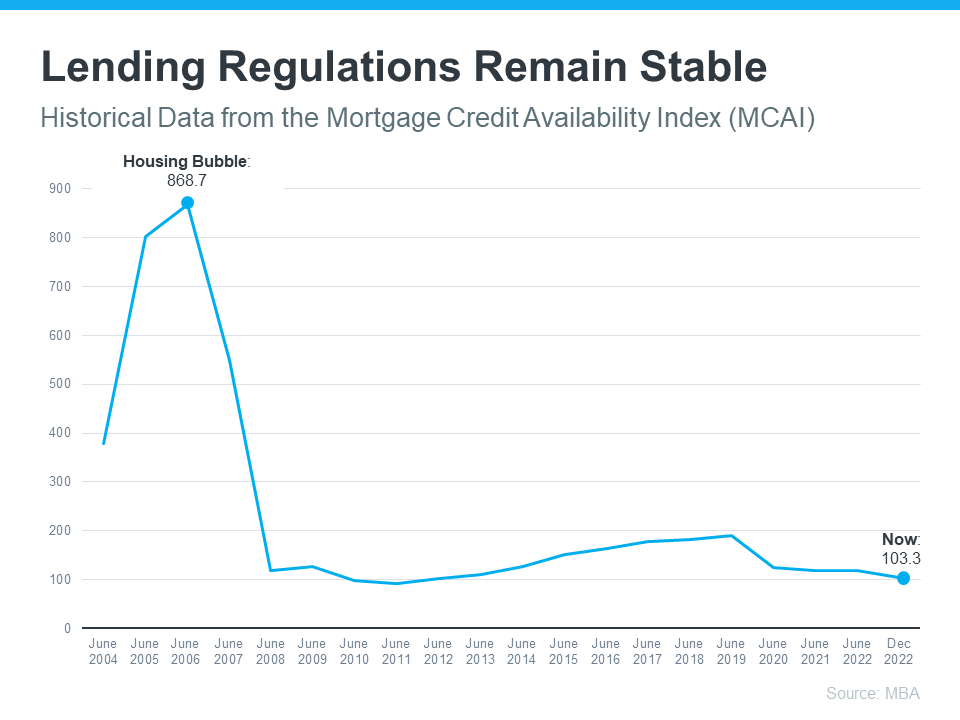
The graph below uses data from the Mortgage Bankers Association (MBA) to help tell this story. In this index, the higher the number, the easier it is to get a mortgage. The lower the number, the harder it is.
This graph also shows just how different things are today compared to the spike in credit availability leading up to the crash. Tighter lending standards have helped prevent a situation that could lead to a wave of foreclosures like the last time.
Foreclosure Volume Has Declined a Lot Since the Crash
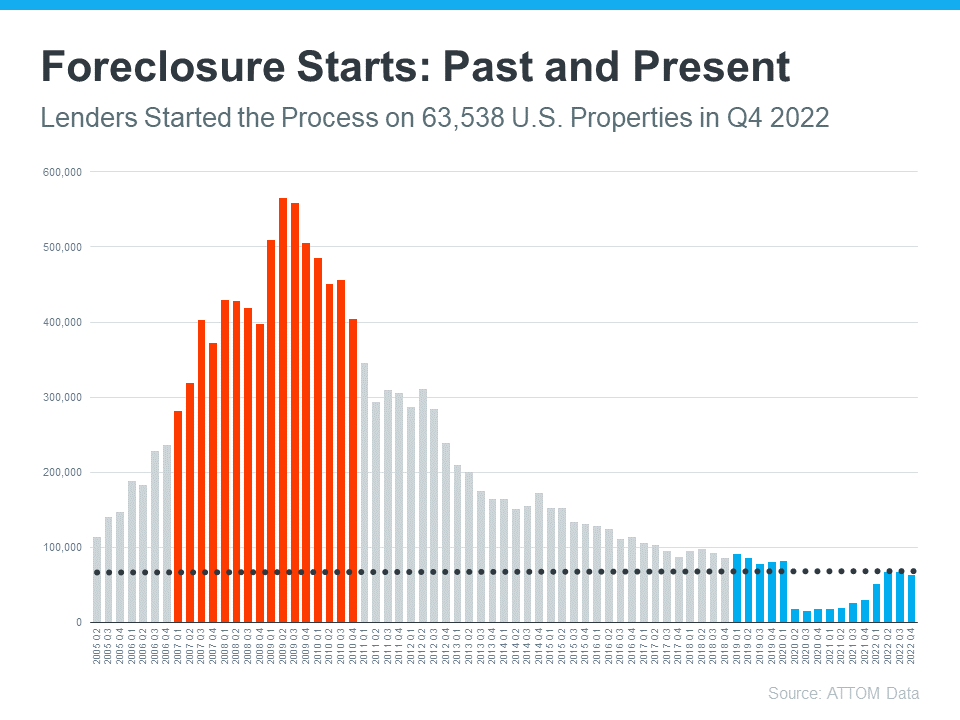
Another difference is the number of homeowners that were facing foreclosure when the housing bubble burst. Foreclosure activity has been lower since the crash, largely because buyers today are more qualified and less likely to default on their loans. The graph below uses data from ATTOM to show the difference between last time and now:
So even as foreclosures tick up, the total number is still very low. And on top of that, most experts don't expect foreclosures to go up drastically like they did following the crash in 2008. Bill McBride, Founder of Calculated Risk, explains the impact a large increase in foreclosures had on home prices back then – and how that's unlikely this time.
The bottom line is there will be an increase in foreclosures over the next year (from record level lows), but there will not be a huge wave of distressed sales as happened following the housing bubble. The distressed sales during the housing bust led to cascading price declines, and that will not happen this time.
The Supply of Homes for Sale Today Is More Limited
For historical context, there were too many homes for sale during the housing crisis (many of which were short sales and foreclosures), and that caused prices to fall dramatically. Supply has increased since the start of this year, but there's still a shortage of inventory available overall, primarily due to years of underbuilding homes.
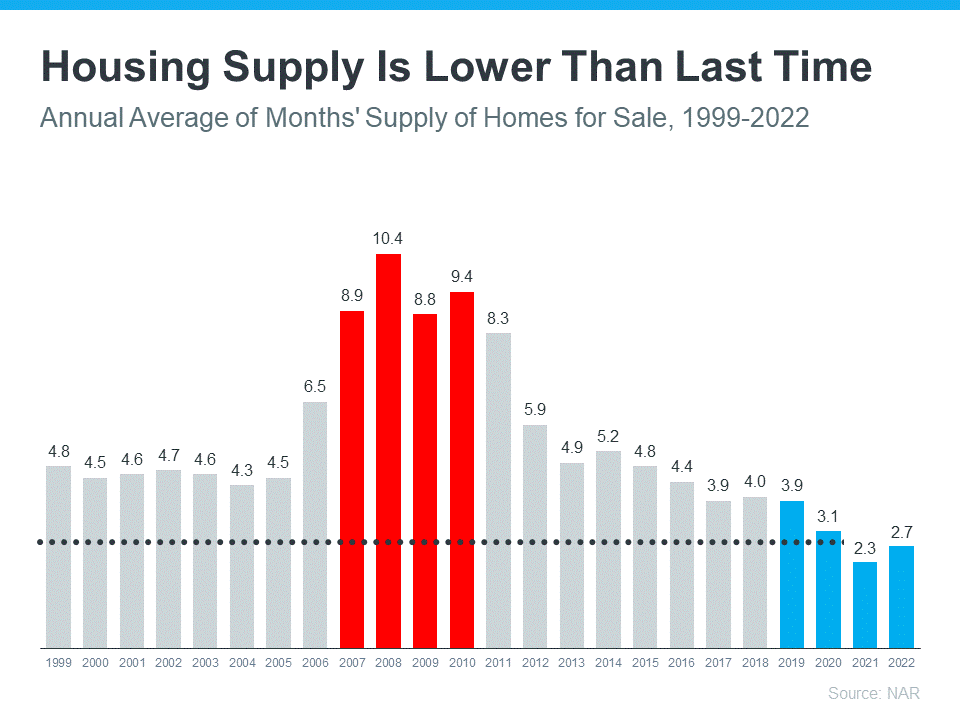
The graph below uses data from the National Association of Realtors (NAR) to show how the months' supply of homes available now compares to the crash. Today, unsold inventory sits at just 2.7-months' supply at the current sales pace, which is significantly lower than the last time. There just isn't enough inventory on the market for home prices to come crashing down like they did last time, even though some overheated markets may experience slight declines.
Bottom Line
If recent headlines have you worried we're headed for another housing crash, the data above should help ease those fears. Expert insights and the most current data clearly show that today's market is nothing like it was last time.
How Experts Can Help Close the Gap in Today's Homeownership Rate

As we celebrate Black History Month, we reflect on the past and present experiences of Black Americans. This includes the path toward investing in a home of their own. And while equitable access to housing has come a long way, homeownership can be a steeper climb for households of color. It's an important experience to talk about, along with how it can make all the difference for diverse homebuyers to work with the right real estate experts.
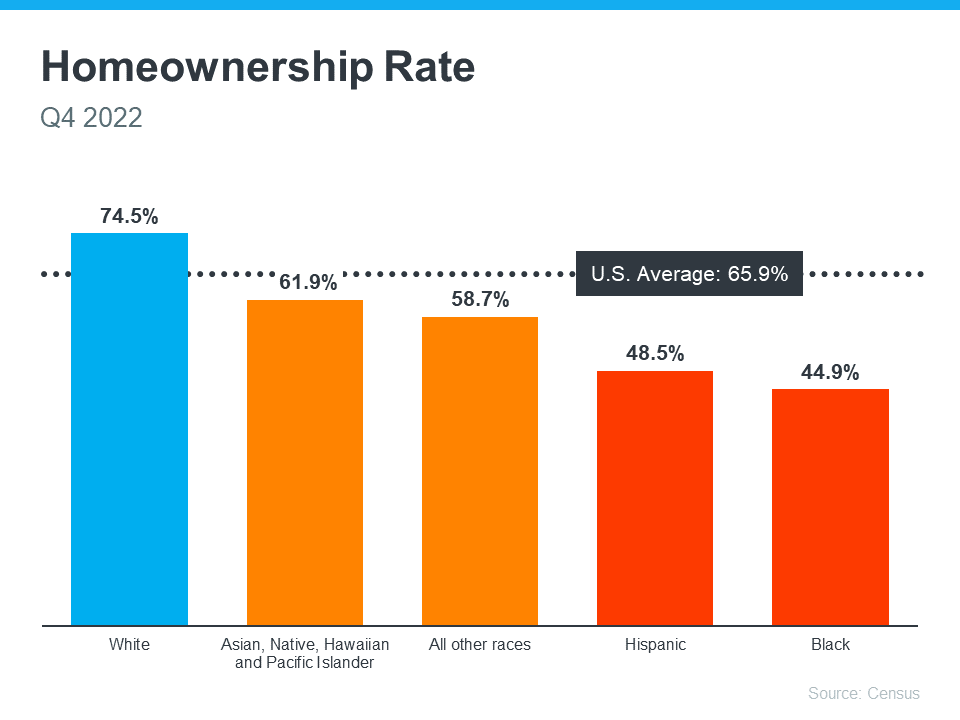
We know it's more challenging for some to buy a home because there's still a measurable gap between the overall average U.S. homeownership rate and that of non-white groups. Today, the lowest homeownership rate persists in the Black community (see graph below):
Homeownership is an essential piece for building household wealth that can be passed down to future generations. However, there are obstacles in the homebuying process that can negatively impact certain groups. This can delay or prevent many from achieving homeownership, challenging their ability to benefit from everything owning a home offers. A recent report from the National Association of Realtors (NAR) explains:
. . . not all [households] have the same opportunities to homeownership, with many of them facing more constraints in their effort to achieve the American Dream. . . . Given that homeownership contributes to wealth accumulation and the homeownership rate is lower in minority groups, data shows that the net worth for these groups is also lower.
However, with the right support and resources, there are solutions if you're part of this community and planning to buy a home. Jacob Channel, Senior Economist at LendingTree, shares:
The problem does exist. We have data that back that up. But there are solutions, and Black homebuyers shouldn't lose faith that they'll never be able to become homeowners.
That's why it's so important for members of diverse groups to have the right team of experts on their sides throughout the homebuying process. These professionals aren't only experienced advisors who understand the local market and give the best advice. They're also compassionate allies who will advocate for your best interests every step of the way.
Bottom Line
Access to housing improves every day, but there are still equity challenges that some buyers face. Let's connect to make sure you have an advocate on your side as you walk the path to homeownership.
|
|
|
Many of today's homeowners bought or refinanced their homes during the pandemic when mortgage rates were at history-making lows. Since rates doubled in 2022, some of those homeowners put their plans to move on hold, not wanting to lose the low mortgage rate they have on their current house. And while today's rates have started coming down from last year's peak, they're still higher than they were a couple of years ago. Today, 93% of outstanding mortgages have a rate at or below 6%. That means a strong majority of homeowners with mortgages have a rate below what they'd get if they moved right now. But if you're a homeowner in that position, remember that mortgage rates aren't the only thing to consider when making a move. Your mortgage rate is important, but there are plenty of reasons you may still need or want to move. RealTrends explains:
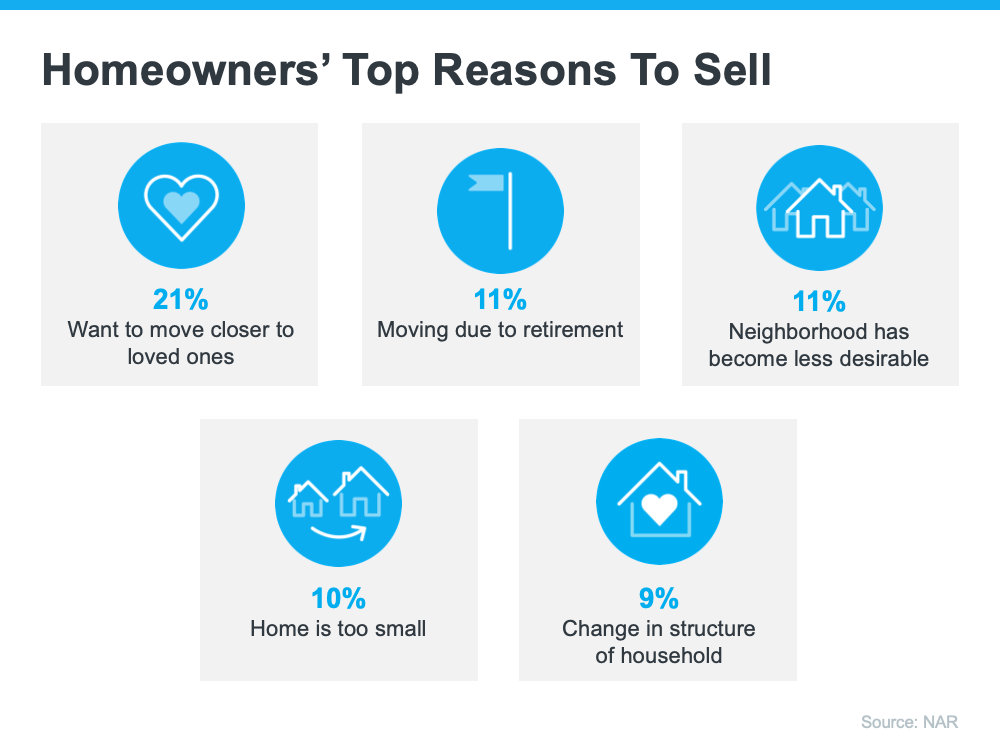
So, if you're on the fence about selling your house, consider the other reasons homeowners are choosing to make a move. A recent report from the National Association of Realtors (NAR) breaks down why homeowners have decided to sell over the past year:
As the visual shows, the most commonly cited reasons for selling were the desire to move closer to loved ones, followed by moving due to retirement, and their neighborhood becoming less desirable. Additionally, the need for more space factored in, as did a change in household structure. If you also find yourself wanting a change in location or needing space your current house just can't provide, it may be time to sell. What you want and need in a home can be reason enough to move. To find out what's right for you, work with a trusted real estate professional who will offer advice and expert guidance throughout the process. They'll be able to lay out all your options – giving you what you need to make a confident decision. Bottom LineWhen deciding whether or not to move, you have a lot to consider. There are plenty of non-financial reasons to factor in. Let's connect today to weigh the benefits of selling your house.
|

![The Spring Housing Market Could Be a Sweet Spot for Sellers [INFOGRAPHIC] Simplifying The Market](https://ecp.yusercontent.com/mail?url=https%3A%2F%2Ffiles.simplifyingthemarket.com%2Fwp-content%2Fuploads%2F2023%2F02%2F16105228%2FThe-Spring-Housing-Market-Could-Be-A-Sweet-Spot-For-Sellers-KCM-Share.png&t=1676645666&ymreqid=fa91d6a0-6d01-c85b-1c18-890001013800&sig=EogiJr0sJOykRXVd3s0q9g--~D)