That House That’s Been Sitting Could Be Your Best Shot at a Deal

BLOGJune 22, 2026


Open up a home search and you'll see them. Listings that have been on the market for two months. Three. Some longer.

Most buyers scroll right past them, assuming something’s wrong with the house. But that instinct could be costing you, since the longer a home sits, the more motivated the seller usually gets.

Where Some Buyers Are Finding Better Deals

If affordability has been your #1 hurdle to buying, here’s a surprisingly simple strategy that could help you finally get your foot in the door. Start with the homes that have been sitting the longest. That’s often where the best deals are.

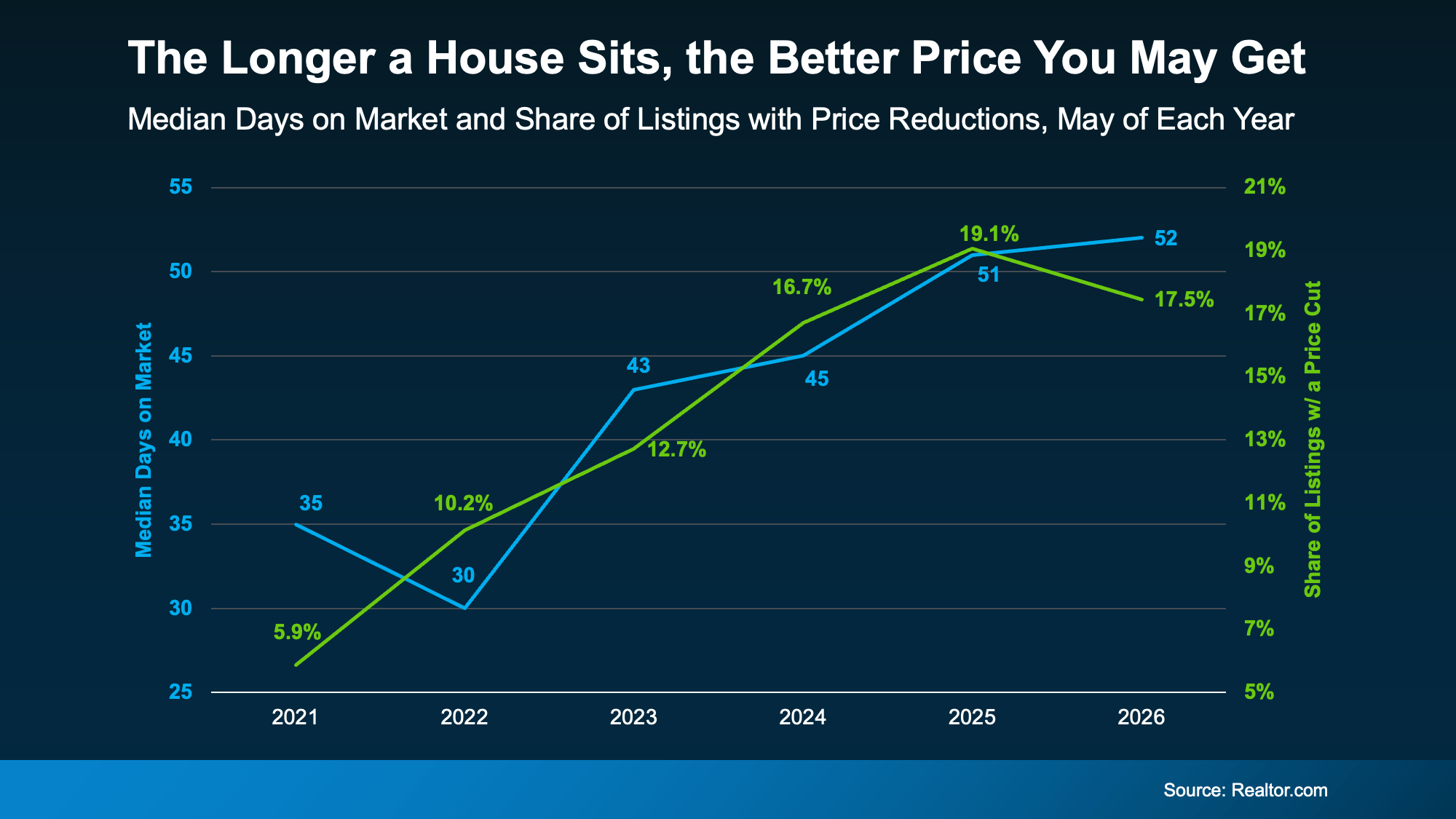
Here’s why. Data from Realtor.com shows there’s a connection between longer time on the market and lower sales prices. Basically, the longer a house sits, the more likely it is that the seller will reduce the price (see graph below):

a graph with numbers and lines

The blue line tracks how long homes stay on the market, while the green line tracks the share of homes getting a price reduction. As one climbs, so does the other.  

And if you focus on these homes that are just sitting and waiting, the opportunity for you is bigger than you may think right now.

Redfin data shows there’s $347 billion worth of stale listings on the market right now – more than ever before for this time of year. So, ask your agent to filter listings for you from oldest to newest. The home that fits your budget might already be there. Just further down the list than you thought.

Lingering Doesn’t Always Mean Something’s Wrong 

Let’s say you do that and something catches your eye. Still, you might be questioning why the home has been sitting in the first place. Just remember, sometimes it has nothing to do with the home itself.

According to Redfin, common causes are:

  • The asking price was set too high to start

  • The home didn’t show well online

  • There are a lot of homes for sale in the area, so it just got buried

So, nothing that’s necessarily a dealbreaker, or even anything that’s wrong with the home itself. If there’s a real issue, a thorough inspection will surface it. And that’s information you can use to negotiate. Not a reason to assume it’s a house worth skipping over.

How To Turn a Lingering Listing into a Win

So how do you capitalize on a lingering listing? According to USA Today, you have two main levers to pull.

The first is price. Work with your agent to study what comparable homes recently sold for, then build an offer around that. Coming in below asking price is fair game when a home has been sitting.

The second is concessions. If a seller won’t budge much on price, they may still help in other ways, like covering some closing costs, repair credits, or even a mortgage rate buydown that lowers your monthly payment.

A local agent has the context to tell which homes are the real opportunities and which are skippable.

Bottom Line

A house sitting on the market isn’t always a glaring red flag. In today’s market, it may be your best opportunity yet.

For help deciding which lingering listings are actually worth a second look, let’s connect.

The information contained, and the opinions expressed, in this article are not intended to be construed as investment advice. Keeping Current Matters, Inc. does not guarantee or warrant the accuracy or completeness of the information or opinions contained herein. Nothing herein should be construed as investment advice. You should always conduct your own research and due diligence and obtain professional advice before making any investment decision. Keeping Current Matters, Inc. will not be liable for any loss or damage caused by your reliance on the information or opinions contained herein.

July 20, 2021

3 Charts That Show This Isn't a Housing Bubble?

3 Charts That Show This Isn't a Housing Bubble

3 Charts That Show This Isn't
a Housing Bubble | MyKCM

With home prices continuing to deliver double-digit increases, some are concerned we're in a housing bubble like the one in 2006. However, a closer look at the market data indicates this is nothing like 2006 for three major reasons.

1. The housing market isn't driven by risky mortgage loans.

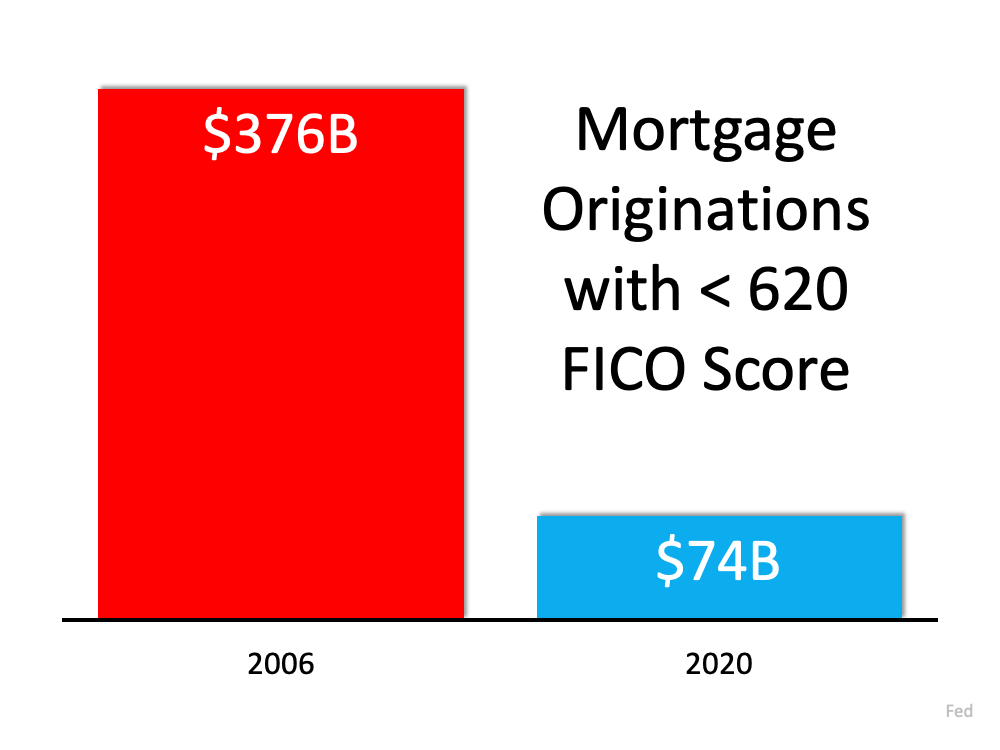
Back in 2006, nearly everyone could qualify for a loan. The Mortgage Credit Availability Index (MCAI) from the Mortgage Bankers' Association is an indicator of the availability of mortgage money. The higher the index, the easier it is to obtain a mortgage. The MCAI more than doubled from 2004 (378) to 2006 (869). Today, the index stands at 130. As an example of the difference between today and 2006, let's look at the volume of mortgages that originated when a buyer had less than a 620 credit score.3
Charts That Show This Isn't a Housing Bubble | MyKCMDr. Frank Nothaft, Chief Economist for CoreLogic, reiterates this point:

There are marked differences in today's run up in prices compared to 2005, which was a bubble fueled by risky loans and lenient underwriting. Today, loans with high-risk features are absent and mortgage underwriting is prudent.

2. Homeowners aren't using their homes as ATMs this time.

During the housing bubble, as prices skyrocketed, people were refinancing their homes and pulling out large sums of cash. As prices began to fall, that caused many to spiral into a negative equity situation (where their mortgage was higher than the value of the house).

Today, homeowners are letting their equity build. Tappable equity is the amount available for homeowners to access before hitting a maximum 80% combined loan-to-value ratio (thus still leaving them with at least 20% equity). In 2006, that number was $4.6 billion. Today, that number stands at over $8 billion.

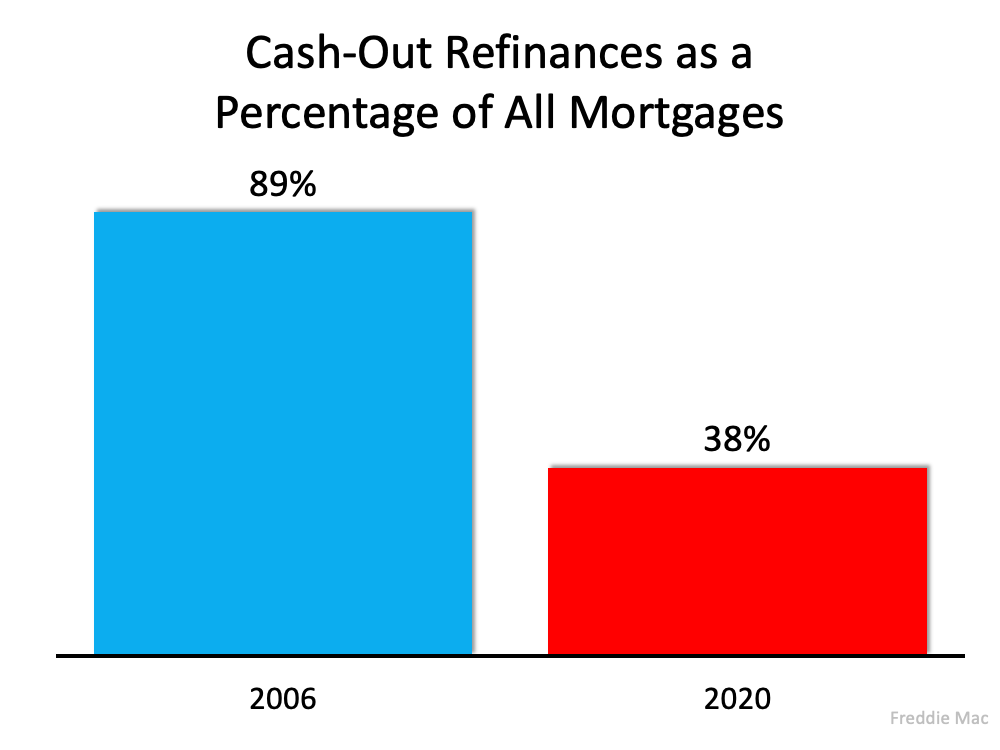
Yet, the percentage of cash-out refinances (where the homeowner takes out at least 5% more than their original mortgage amount) is half of what it was in 2006.3
Charts That Show This Isn't a Housing Bubble | MyKCM

3. This time, it's simply a matter of supply and demand.

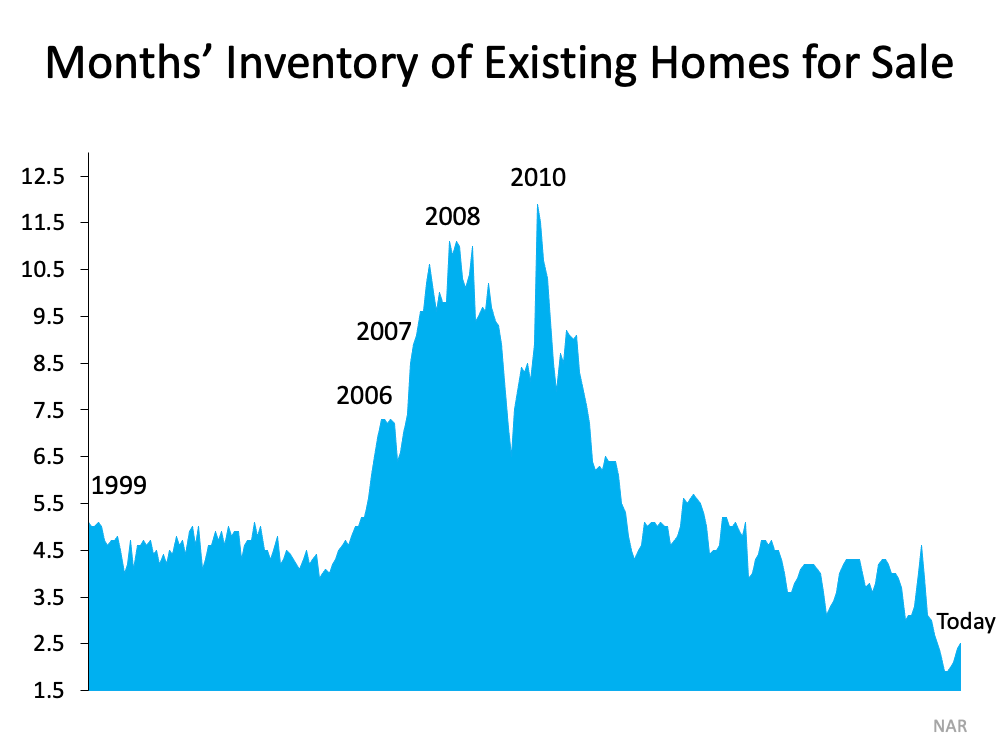
FOMO (the Fear Of Missing Out) dominated the housing market leading up to the 2006 housing bubble and drove up buyer demand. Back then, housing supply more than kept up as many homeowners put their houses on the market, as evidenced by the over seven months' supply of existing housing inventory available for sale in 2006. Today, that number is barely two months.

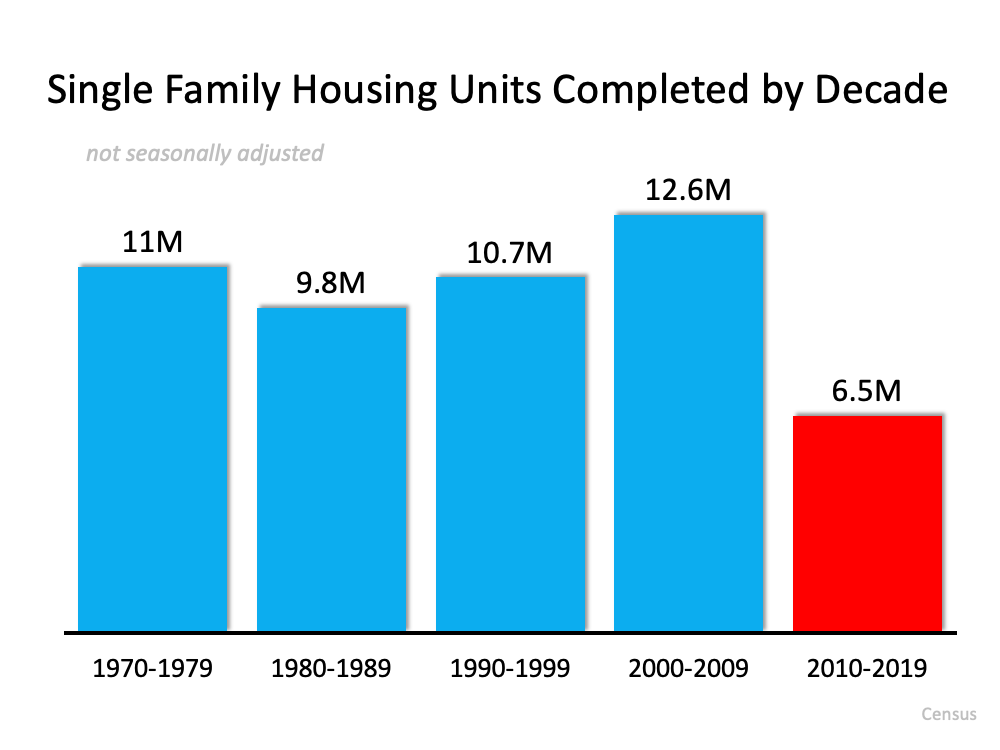
Builders also overbuilt during the bubble but pulled back significantly over the next decade. Sam Khater, VP and Chief Economist, Economic & Housing Research at Freddie Macexplains that pullback is the major factor in the lack of available inventory today:

The main driver of the housing shortfall has been the long-term decline in the construction of single-family homes.

Here's a chart that quantifies Khater's remarks:3
Charts That Show This Isn't a Housing Bubble | MyKCMToday, there are simply not enough homes to keep up with current demand.

Bottom Line

This market is nothing like the run-up to 2006. Bill McBride, the author of the prestigious Calculated Risk blog, predicted the last housing bubble and crash. This is what he has to say about today's housing market:

It's not clear at all to me that things are going to slow down significantly in the near future. In 2005, I had a strong sense that the hot market would turn and that, when it turned, things would get very ugly. Today, I don't have that sense at all, because all of the fundamentals are there. Demand will be high for a while because Millennials need houses. Prices will keep rising for a while because inventory is so low.


Posted in Market Updates
July 15, 2021

Diving Deep into Today's Biggest Buyer Concerns?

Diving Deep into Today's Biggest Buyer Concerns

Diving Deep into Today's
Biggest Buyer Concerns | MyKCM

Last week, Fannie Mae released their Home Purchase Sentiment Index (HPSI). Though the survey showed 77% of respondents believe it's a good time to sell, it also confirms what many are sensing: an increasing number of Americans believe it's a bad time to buy a home. The percentage of those surveyed saying it's a bad time to buy hit 64%, up from 56% last month and 38% last July.

The latest HPSI explains:

Consumers also continued to cite high home prices as the predominant reason for their ongoing and significant divergence in sentiment toward homebuying and home-selling conditions. While all surveyed segments have expressed greater negativity toward homebuying over the last few months, renters who say they are planning to buy a home in the next few years have demonstrated an even steeper decline in homebuying sentiment than homeowners. It's likely that affordability concerns are more greatly affecting those who aspire to be first-time homeowners than other consumer segments.

Let's look closely at the market conditions that impact home affordability.

A mortgage payment is determined by the price of the home and the mortgage rate on the loan used to purchase it. Lately, monthly mortgage payments have gone up for buyers for two key reasons:

  1. Mortgage rates have increased from 2.65% this past January to 2.9%.
  2. Home prices have increased by 15.4% over the last 12 months.

Based on these rising factors, a home may be less affordable today, but it doesn't mean it's not affordable.

Three weeks ago, ATTOM Data released their second-quarter 2021 U.S. Home Affordability Report which explained that the major ownership costs on the typical home as a percent of the average national wage had increased from 22.2% in the second quarter of 2020 to 25.2% in the second quarter of this year. They also went on to explain:

Still, the latest level is within the 28 percent standard lenders prefer for how much homeowners should spend on mortgage payments, home insurance and property taxes.

In the same report, Todd Teta, Chief Product Officer with ATTOM, confirms:

Average workers across the country can still manage the major expenses of owning a home, based on lender standards.

It's true that monthly mortgage payments are greater than they were last year (as the ATTOM data shows), but they're not unaffordable when compared to the last 30 years. While payments have increased dramatically during that several-decade span, if we adjust for inflation, today's mortgage payments are 10.7% lower than they were in 1990.

What's that mean for you? While you may not get the homebuying deal someone you know got last year, that doesn't mean you shouldn't still buy a home. Here are your alternatives to buying and the trade-offs you'll have with each.

Alternative 1: I'll rent instead.

Some may consider renting as the better option. However, the monthly cost of renting a home is skyrocketing. According to the July National Rent Report from Apartment List:

So far in 2021, rental prices have grown a staggering 9.2%. To put that in context, in previous years growth from January to June is usually just 2 to 3%. After this month's spike, rents have been pushed well above our expectations of where they would have been had the pandemic not disrupted the market.

If you continue to rent, chances are your rent will keep increasing at a fast pace. That means you could end up spending significantly more of your income on your rental as time goes on, which could make it even harder to save for a home.

Alternative 2: I'll wait it out.

Others may consider waiting for another year and hoping that purchasing a home will be less expensive then. Let's look at that possibility.

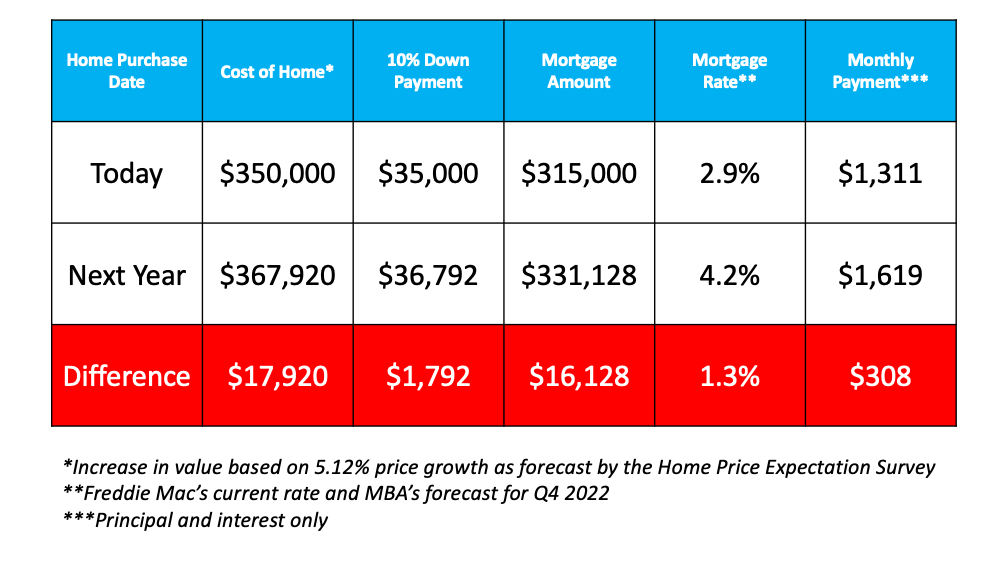
We've already established that a monthly mortgage payment is determined by the price of the home and the mortgage rate. A lower monthly payment would require one of those two elements to decrease over the next year. However, experts are forecasting the exact opposite:

  • The Mortgage Bankers Association (MBA) projects mortgage rates will be at 4.2% by the end of next year.
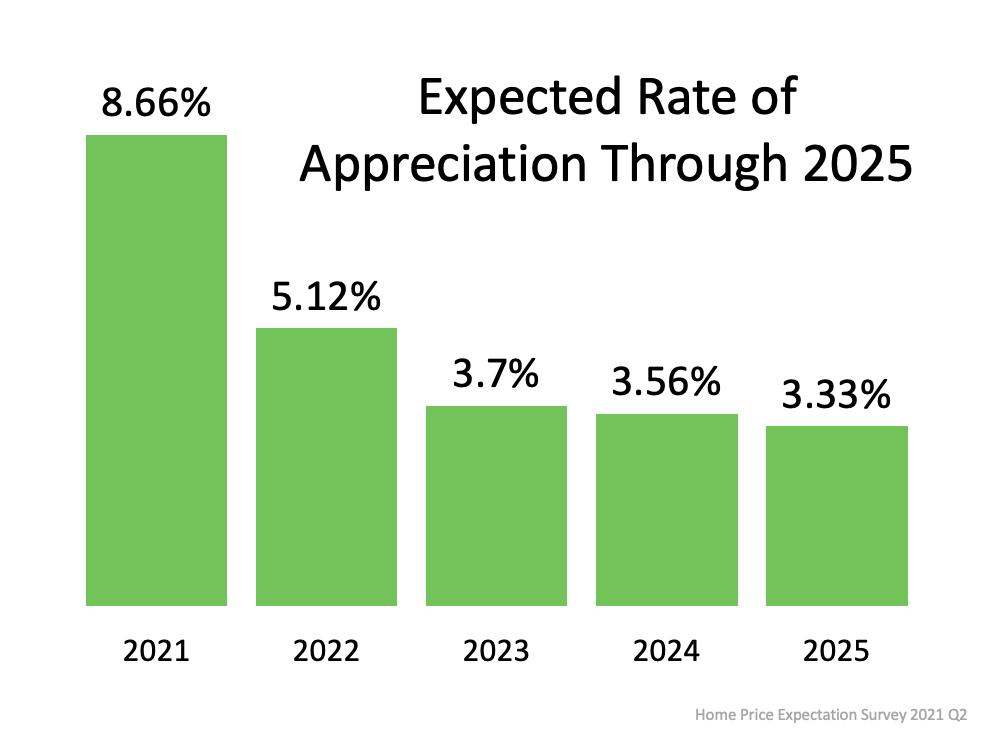
  • The Home Price Expectation Survey (HPES), a survey of over 100 economists, investment strategists, and housing market analysts, calls for home prices to increase by 5.12% in 2022.

Based on these projections, let's see the possible impact on a monthly mortgage payment:Diving Deep into Today's Biggest Buyer Concerns | MyKCMBy waiting until next year, you'd potentially pay more for the home, need a larger down payment, pay a higher mortgage rate, and pay an additional $3,696 each year over the life of the mortgage.

Bottom Line

While you may have missed the absolute best time to buy a home, waiting any longer may not make sense. Mark Fleming, Chief Economist at First Americansays it best:

Affordability is likely to worsen before it improves, so try to buy it now, if you can find it.


Posted in Market Updates
July 14, 2021

Housing Supply Is Rising. What Does That Mean for You??

Housing Supply Is Rising. What Does That Mean for You?

Housing Supply Is Rising.
What Does That Mean for You? | MyKCM

An important factor in today's market is the number of homes for sale. While inventory levels continue to sit near historic lows, there are indications we may have hit the lowest point we'll see. Odeta Kushi, Deputy Chief Economist at First American, recently said of our supply challenges:

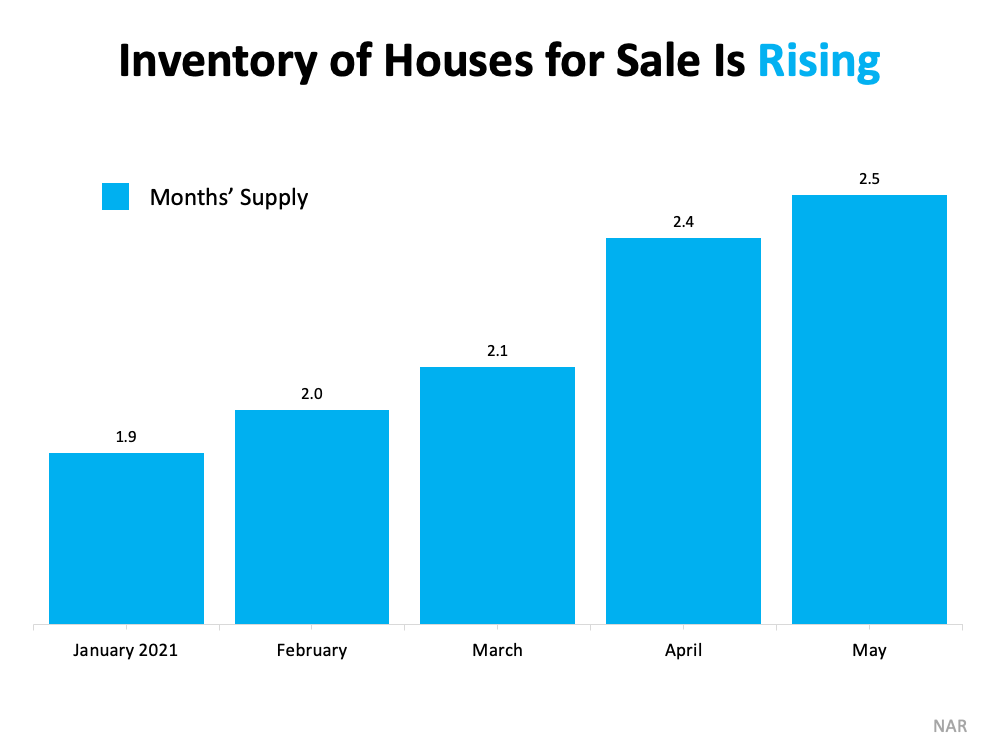
It looks like inventory may have hit a bottom (we've seen this in the higher frequency data as well). Unsold inventory in May was at 2.5 months supply, up from 2.4.

To put it into perspective, the graph below shows levels of inventory rising since the beginning of the year:Housing Supply Is Rising. What Does That Mean for You? | MyKCMWe're still not close to a balanced market, which would be a 6 months' supply of homes for sale. However, we are seeing a slow but steady increase in homes coming up for sale. And that leaves many buyers and sellers wondering the same thing: what does that mean for me?

Buyers: More Options Are Arriving, so It's Time To Act

If you're a buyer, more inventory coming to market is a welcome sight. More supply means more options and less competition, which could mean fewer bidding wars.

According to the latest Monthly Housing Market Trends Report, supply levels are continuing to increase, which is different from the typical summer market:

In June, newly listed homes grew by 5.5% on a year-over-year basis, and by 10.9% on a month-over-month basis. Typically, fewer newly listed homes appear on the market in the month of June compared to May. This year, growth in new listings is continuing later into the summer season, a welcome sign for a tight housing market.

If you're having trouble finding your next home, this news should give you the hope and motivation to keep your buying process moving forward. Experts project mortgage rates will begin increasing, which will make purchasing a home less affordable as time passes. You can still capitalize on today's low interest rates, so stick with your search as more homes come to market.

Sellers: Our Supply Challenges Aren't Over Yet, so Now Is the Time To Sell

If you've been putting off selling your house, you shouldn't wait much longer. The year's month-over-month gains in homes for sale have helped buyers, but we're still very much in a sellers' market.

As the graph below shows, even with the number of homes for sale rising, we're still well below the supply levels we've seen historically:Housing Supply Is Rising. What Does That Mean for You? | MyKCMOf course, more homes are coming to market now, and more are expected in the coming months. Selling your house this summer gives you the chance to get ahead of the competition and maximize your sales potential before more homes are put up for sale in your neighborhood.

Bottom Line

More homes for sale means more options for buyers and more competition for sellers. Whether you're looking to buy or sell, let's connect today to discuss your options and why it's still a good time to make your move.


Posted in Market Updates
July 13, 2021

Why This Isn't Your Typical Summer Housing Market?

Why This Isn't Your Typical Summer Housing Market

Why This Isn't Your Typical
Summer Housing Market | MyKCM

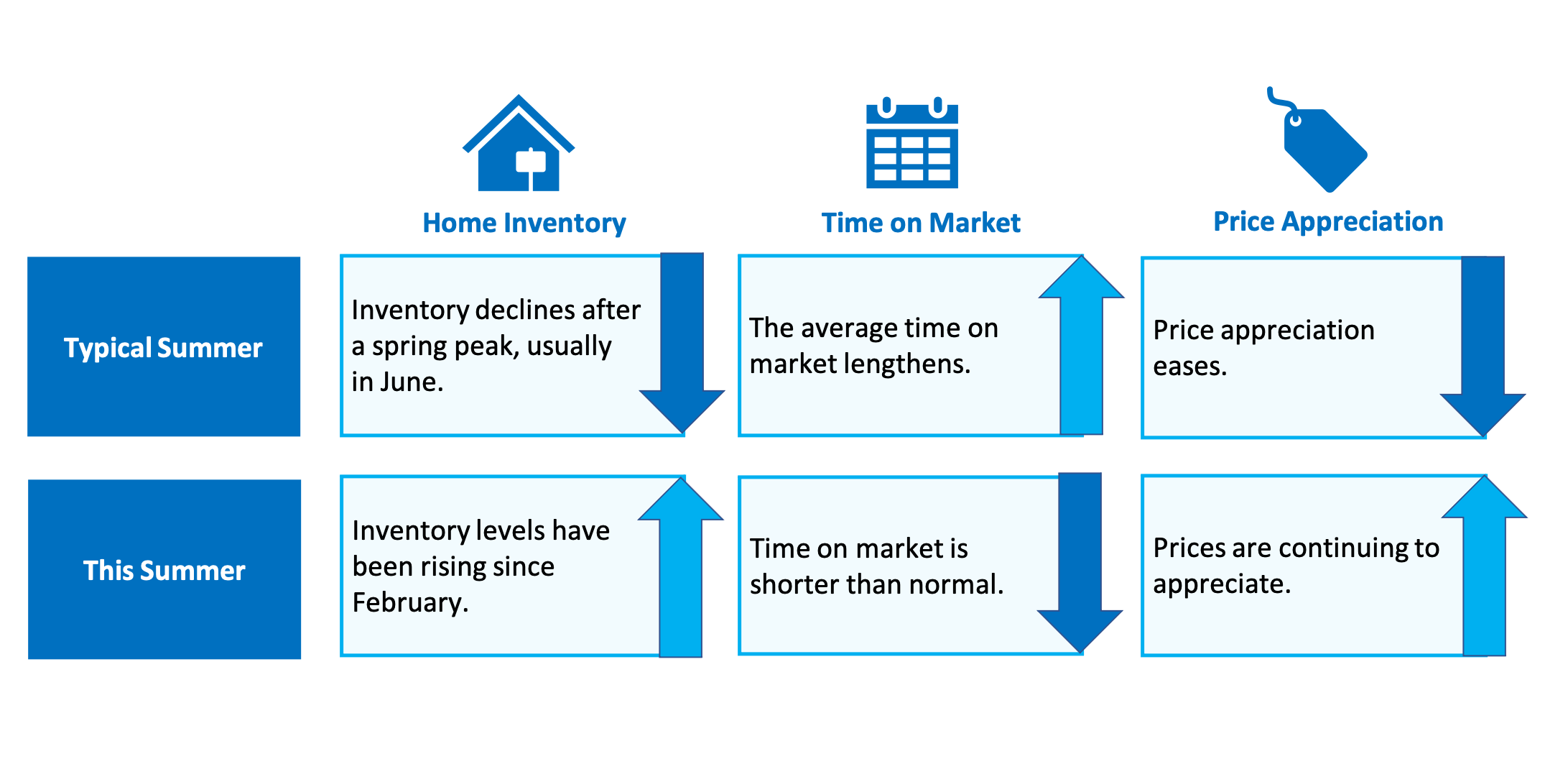
In real estate, it's normal to see ebbs and flows in the market. Typically, the summer months are slower-paced than the traditionally busy spring. But this isn't a typical summer. As the economy rebounds and life is returning to normal, the real estate market is expected to have an unusually strong summer season.

Here's how this summer is stacking up against the norm and what it means for you.Why
This Isn't Your Typical Summer Housing Market | MyKCM

Inventory is increasing.

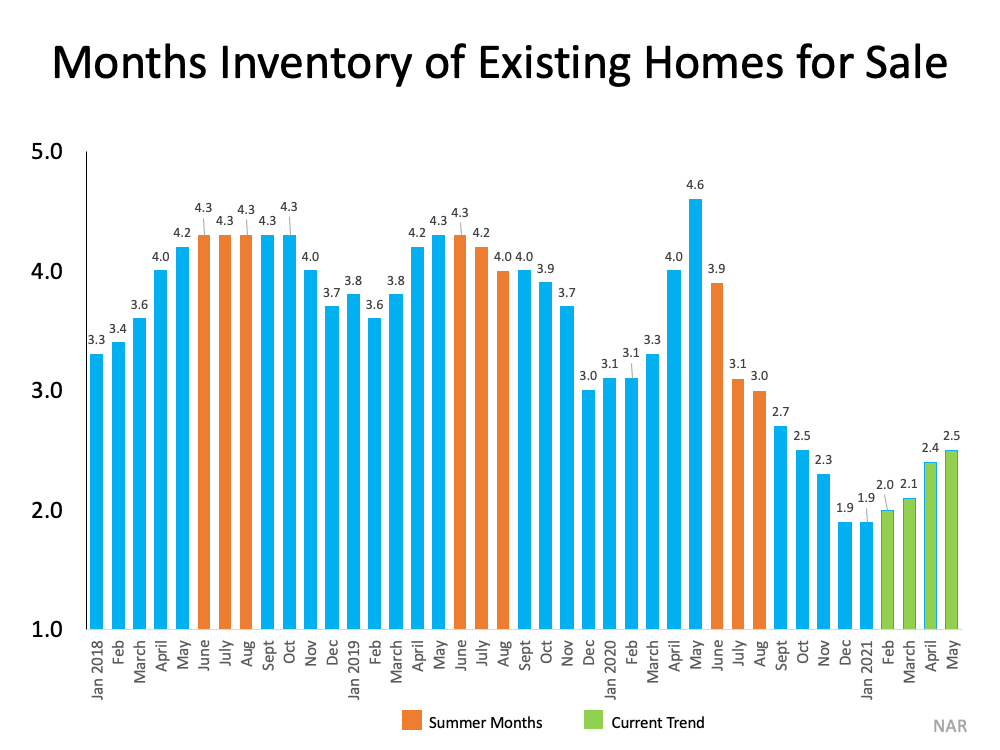
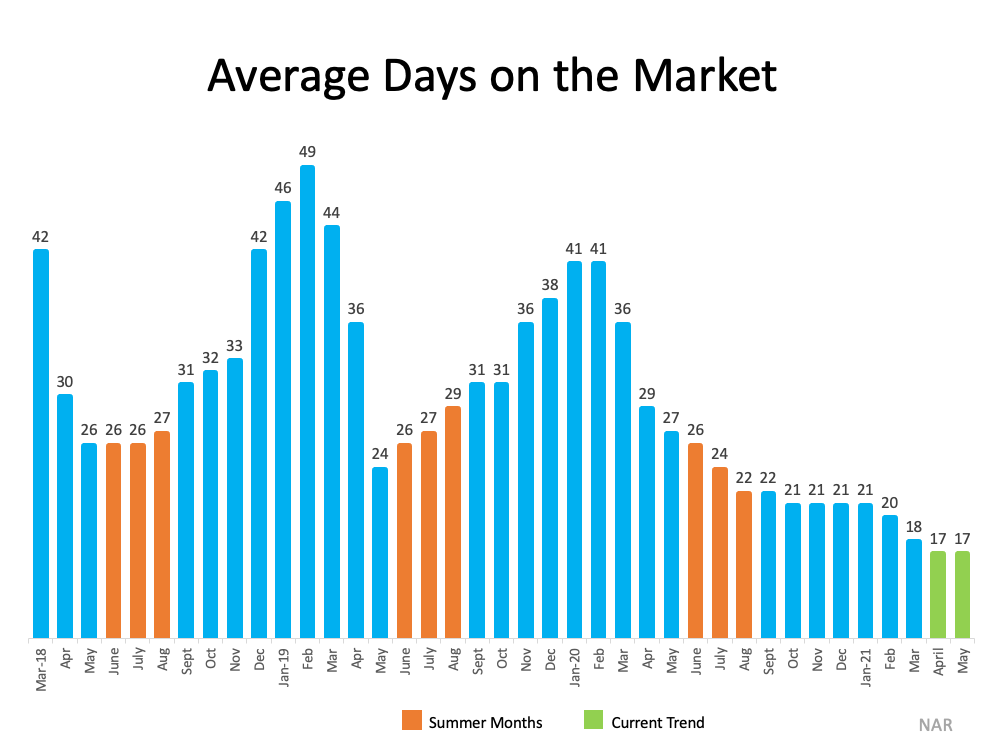
According to the latest Existing Home Sales Report from the National Association of Realtors (NAR), inventory levels have been rising since February of this year. Looking at the graph below, there's a clear upward trend, as shown in the green bars. Currently, there's roughly a 2.5 months' supply of homes for sale. And while inventory is trending up as more houses are coming to the market, it's still much lower than several of the previous summers, as the orange bars indicate.Why
This Isn't Your Typical Summer Housing Market | MyKCMIf you're looking to buy, some relief is on the way in the form of more homes coming to the market. Just remember, we still have less inventory than the norm, so be patient in your search.

If you're thinking of selling, now is the time. Work with your agent to list your house before it has more competition on the market.

Time on the market is still shorter than normal.

Unlike the typical summer trend, time on the market is moving at the fastest speed we've seen since NAR started collecting this survey-based information in 2011. The most recent Realtors Confidence Index shows that the average home is on the market for just 17 days, as shown in green in the graph below. This means houses are selling at a much faster pace than a typical summer, which the orange bars represent.Why
This Isn't Your Typical Summer Housing Market | MyKCMIf you're looking to buy, this means you need to be prepared to move fast. Brace for a quick pace and rely on your agent to stay in the know on the available homes in your area.

If you're thinking of selling, data shows your house will likely sell quickly. If you're worried about where you'll go once your house sells, consider a newly built home as a good way to move up.

Price appreciation is still rising.

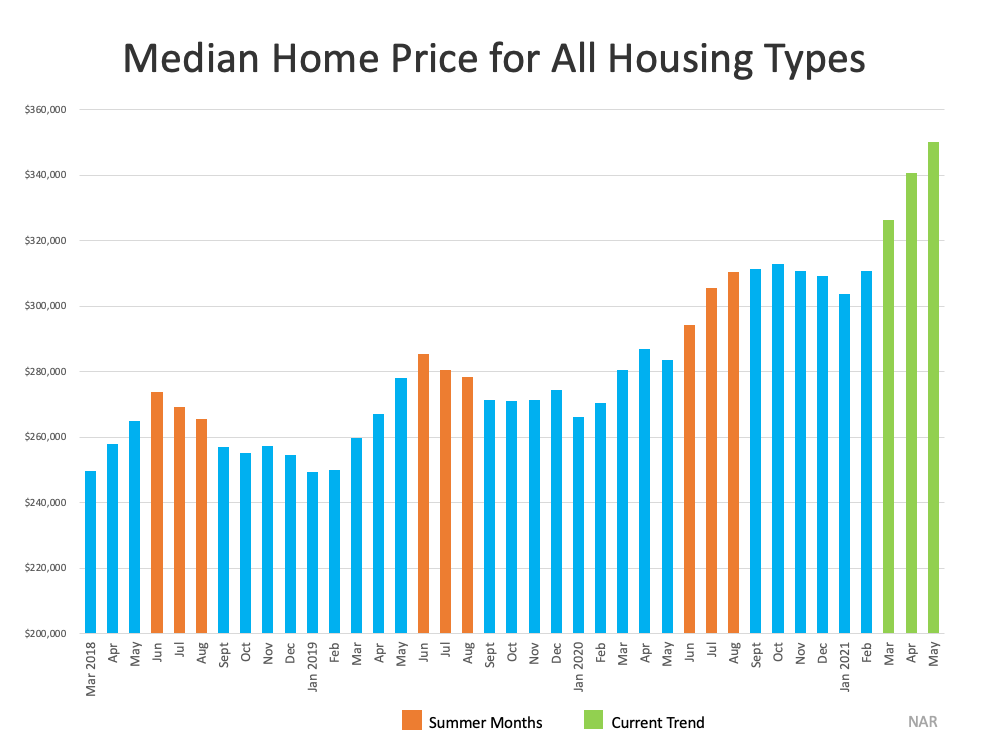
The last big factor making this an unusually strong market this summer is home price appreciation. According to the State House Price Index from the Federal Housing Finance Agency (FHFA), we're currently experiencing double-digit house price appreciation and have an average of 12.6% appreciation across the country. The graph below uses data from NAR to show a more granular view of how prices have changed month-to-month over the past few years. The green bars show the current price appreciation we're experiencing today. Our current levels are well above what we've seen in recent summers, shown by the orange bars.Why
This Isn't Your Typical Summer Housing Market | MyKCMIf you're looking to buy, competition and bidding wars are driving prices up. Getting pre-approved can show the seller you're serious and help you know what you can afford. Once you do, work with your agent to make a strong offer that stands out.

If you're thinking of selling, seize this opportunity to use your additional equity from this price appreciation to power your next move.

Bottom Line

This isn't a typical summer. Whether you're buying or selling, let's connect to talk about how you can capitalize on today's market conditions to sell your house or find your dream home.


Posted in Market Updates
July 12, 2021

4 Major Incentives To Sell This Summer?

4 Major Incentives To Sell This Summer

4 Major Incentives To Sell
This Summer | MyKCM

While the housing market forecast for the second half of the year remains positive, there may not be a better time to sell than right now. Here are four things to consider if you're trying to decide if now's the right time to make a move.

1. Your House Will Likely Sell Quickly

According to the most recent Realtors Confidence Index released by the National Association of Realtors (NAR), homes continue to sell quickly. The report notes homes are selling in an average of just 17 days.

Average days on market is a strong indicator of buyer competition, and homes selling quickly is a great sign for sellers. It's one of several factors that indicate buyers are motivated to do what it takes to purchase the home of their dreams.

2. Buyers Are Willing To Compete for Your House

In addition to selling fast, homes are receiving multiple offers. NAR reports sellers are seeing an average of 5 offers, and these offers are competitive ones. Shawn Telford, Chief Appraiser at CoreLogicsaid in a recent interview:

The frequency of buyers being willing to pay more than the market data supports is increasing.

This confirms buyers are ready and willing to enter bidding wars for your home. Receiving several offers on your house means you can select the one that makes the most sense for your situation and financial well-being.

3. When Supply Is Low, Your House Is in the Spotlight

One of the most significant challenges for motivated buyers is the current inventory of homes for sale, which while improving, remains at near-record lows. As NAR details:

Total housing inventory at the end of May amounted to 1.23 million units, up 7.0% from April’s inventory and down 20.6% from one year ago (1.55 million). Unsold inventory sits at a 2.5-month supply at the present sales pace, marginally up from April’s 2.4-month supply but down from 4.6-months in May 2020.

There are signs, however, that more homes are coming to market. Odeta Kushi, Deputy Chief Economist at First Americannotes:

It looks like existing inventory is starting to inch up, which is good news for a housing market parched for more supply.

If you're looking to take advantage of buyer demand and get the most attention for your house, selling now before more listings come to the market might be your best option.

4. If You're Thinking of Moving Up, Now May Be the Time

Over the past 12 months, homeowners have gained a significant amount of wealth through growing equity. In that same period, homeowners have also spent a considerable amount of time in their homes, and many have decided their house doesn't meet their needs.

If you're not happy with your current home, you can leverage that equity to power your move now. Your equity, plus current low mortgage rates, can help you maximize your purchasing power.

But these near-historic low rates won't last forever. Experts forecast interest rates will increase in the coming months. Nadia Evangelou, Senior Economist and Director of Forecasting at NARsays:

Nevertheless, as the economic outlook for the United States looks brighter for the rest of the year, mortgage rates are expected to rise in the following months.

As interest rates rise, even modestly, it could influence buyer demand and your purchasing power. If you've been waiting for the best time to sell to fuel your move up, you likely won't find more favorable conditions than those we're seeing today.

Bottom Line

With supply challenges, low mortgage rates, and extremely motivated buyers, sellers are well-positioned to take advantage of current market conditions right now. If you're thinking about selling, let's connect today to discuss why it makes sense to list your home sooner rather than later.


Posted in Market Updates
July 8, 2021

Selling Your House? Make Sure You Price It Right.?

Selling Your House? Make Sure You Price It Right.

Selling Your House? Make Sure
You Price It Right. | MyKCM

There's no denying we're in a sellers' market. With low inventory and high buyer demand, homes today are selling above the asking price at a record rate. According to the latest Realtors Confidence Index Survey from the National Association of Realtors (NAR):

  • Homes typically sell within 17 days (compared to 26 days one year ago).
  • The average home sold has five offers to pick from.
  • 54% of offers are over the asking price.

Because so many buyers are competing for so few homes, bidding wars are driving up home prices. According to an average of leading expert projections, existing home prices are expected to increase by 8.9% this year.

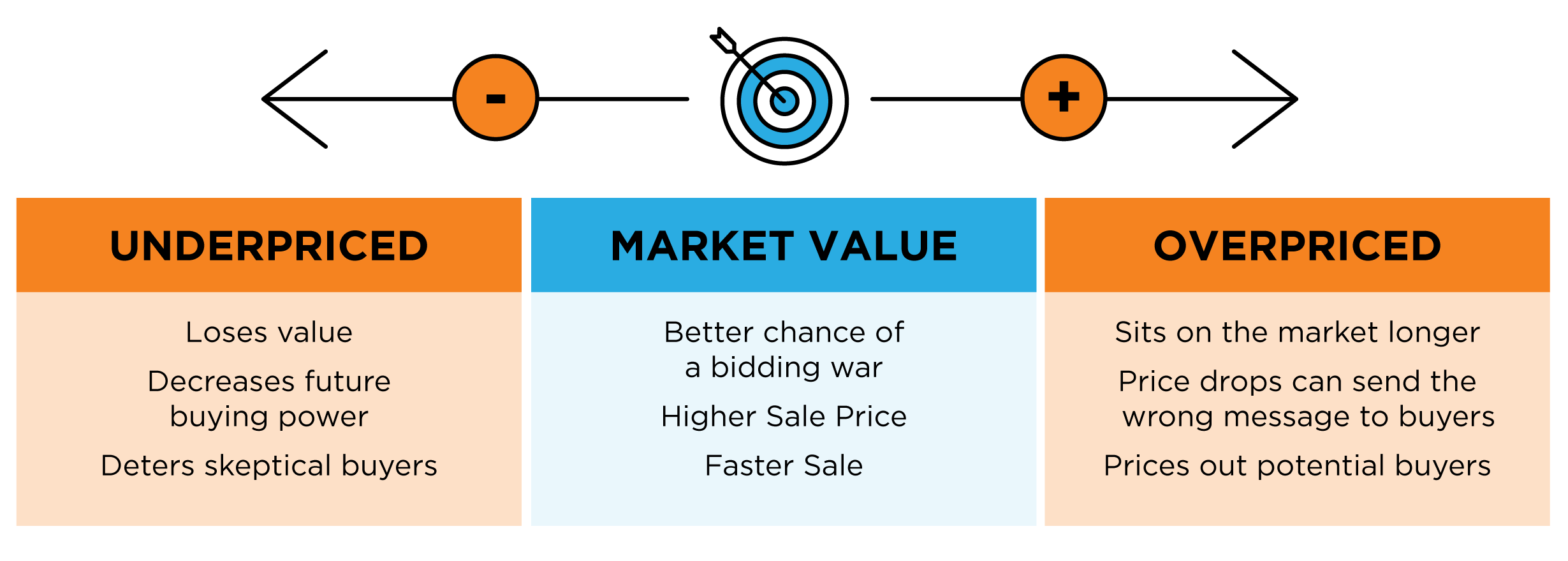
Yet even in today's red-hot sellers' market, it's important to price your house right. While it may be tempting to price your house on the high side to capitalize on this trend, doing so could limit your house's potential.

Why Pricing Your House Right Matters

Here's the thing – a high price tag doesn't mean you're going to cash in big on the sale. While you may be trying to maximize your return, the tradeoff may be steep. A high list price is more likely to deter buyers, sit on the market longer, or require a price drop that can raise questions among prospective buyers.

Instead, focus on setting a price that's fair. Real estate professionals know the value of your home. By pricing your house based on its current condition and similar homes that have recently sold in your area, your agent can help you set a price that's realistic and obtainable – and that's good news for you and for buyers.Selling Your House? Make Sure You Price It Right. | MyKCMWhen you price your house right, you increase your home's visibility, which drives more buyers to your front door. The more buyers that tour your home, the more likely you'll have a multi-offer scenario to create a bidding war. When multiple buyers compete for your house, that sets you up for a bigger win.

Bottom Line

When it comes to pricing your house, working with a local real estate professional is essential. Let's connect so we can optimize your exposure, your timeline, and the return on your investment, too.


Posted in Market Updates
July 6, 2021

A Look at Home Price Appreciation Through 2025?

A Look at Home Price Appreciation Through 2025

A Look at Home Price
Appreciation Through 2025 | MyKCM

Home prices have increased significantly over the last year, which in turn has grown the net worth of homeowners. Appreciation and home equity are directly linked – as the value of a home increases, so does a homeowner's equity. And with these recent gains, homeowners are witnessing their financial stability and well-being grow to record levels.

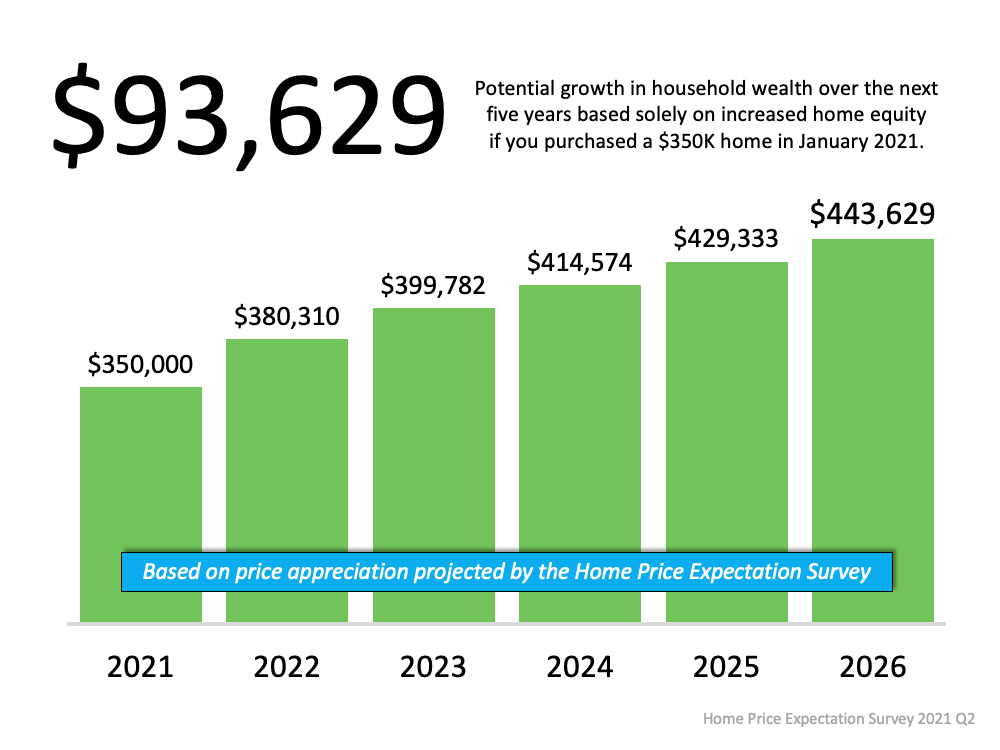
In more good news for homeowners, the most recent Home Price Expectations Survey – a survey of a national panel of over one hundred economists, real estate experts, and investment and market strategists – forecasts home prices will continue appreciating over the next five years, adding to the record amount of equity homeowners have already gained over the past year. Below are the expected year-over-year rates of home price appreciation from the report:A
Look at Home Price Appreciation Through 2025 | MyKCM

What Does This Mean for Homeowners?

Home prices are climbing today, and the data in the survey indicates they'll continue to increase, but at rates that approach a more normal pace. Even still, the amount of household wealth a homeowner stands to earn going forward is substantial. This truly becomes clear when we consider a scenario using a median-priced home purchased in January of 2021 and the projected rate of appreciation on that home over the next five years. As the graph below illustrates, a homeowner could increase their net worth by a significant amount – over $93,000 dollars by 2026.A
Look at Home Price Appreciation Through 2025 | MyKCM

Home Price Appreciation and Home Equity

CoreLogic recently released their quarterly Homeowner Equity Insights Report, which tracks the year-over-year increases in equity. It shows an average annual gain of $33,400 per borrower over the past 12 months. In the report, Dr. Frank Nothaft, Chief Economist for CoreLogic, further explains:

Double-digit home price growth in the past year has bolstered home equity to a record amount. The national CoreLogic Home Price Index recorded an 11.4% rise in the year through March 2021, leading to a $216,000 increase in the average amount of equity held by homeowners with a mortgage.

The expected, sustained growth of home prices means homeowners can continue to build on the past year's record levels of home equity – and their financial prosperity. It also presents today's homeowners with a unique opportunity: using their growing equity for a home upgrade. With so few homes available to purchase and strong buyer demand, there may not be a better time to sell your current house and move into one that better meets your needs.

Bottom Line

Home prices are expected to continue appreciating over the next five years, and the associated equity gains are the quickest way homeowners can build household wealth. If you’re a current homeowner who's ready to take advantage of your built-up equity, let's connect today to discuss your options.


Posted in Market Updates
July 6, 2021

Home Builders Ramp Up Construction Based on Demand?

Home Builders Ramp Up Construction Based on Demand

Home Builders Ramp Up
Construction Based on Demand | MyKCM

If you're thinking of buying a home, there really is no time like the present. With today's low mortgage rates, you have a great opportunity to get more home for your money. The challenge is inventory. Like you, many buyers want to capitalize on these market conditions, and it's leading to more buyer competition and bidding wars.

If you're having a hard time finding a home to buy, it may be time to talk to your trusted real estate advisor about a newly built home. Early indicators show new-home construction is beginning to ramp up. While new homes alone won't be able to fix all of the inventory challenges, this does mean you'll soon have more options as you search for a home. As a buyer, a newly built home may be exactly what you're looking for – it's brand new, and with builder customization options, it's uniquely yours from the ground up.

Here's what industry experts are saying about new homes coming to market:

Nadia Evangelou, Senior Economist and Director of Forecasting at the National Association of Realtors (NAR), says recent research could indicate upward momentum when it comes to new home construction. Evangelou refers to the volume of new homes where construction began during a set period, known in the industry as housing starts.

According to that research, housing starts reached their highest level since 2006 in March of this year – an encouraging sign for the industry. While they dipped slightly in April, Evangelou reiterates that the level of housing construction is heading in a positive direction compared to recent years:

we are currently building 24% more homes than we typically have built in April in the last couple of decades. Thus, housing construction is trending upward with housing starts likely to reach 1.6 million for all of 2021 and rise further to 1.7 million in 2022.

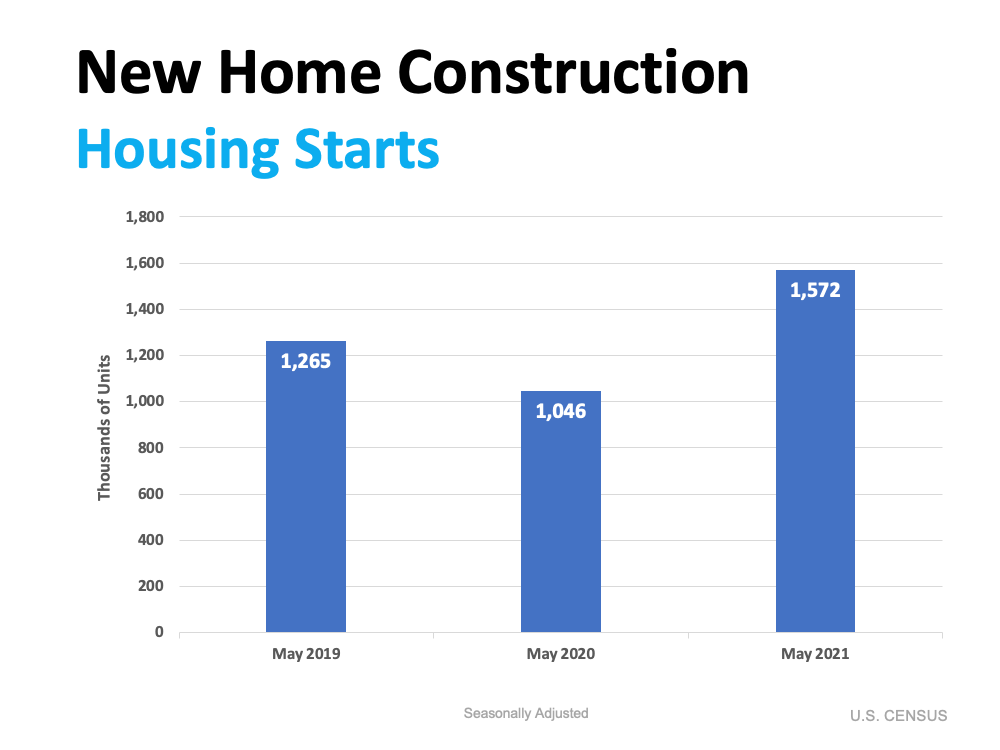
As new data pours in, it further confirms this trend. According to the latest Monthly New Residential Construction report from the U.S. Census Bureau, housing starts increased even more in May, which continues the ongoing upward trend (see graph below) and indicates that ground is being broken on even more new homes.Home
Builders Ramp Up Construction Based on Demand | MyKCMRobert Dietz, Chief Economist and Senior Vice President of Economics and Housing Policy for the National Association of Home Builders (NAHB), singles out another encouraging sign:

It is also worth noting that the number of single-family homes permitted but not started construction continued to increase in May, rising to 142,000 units.

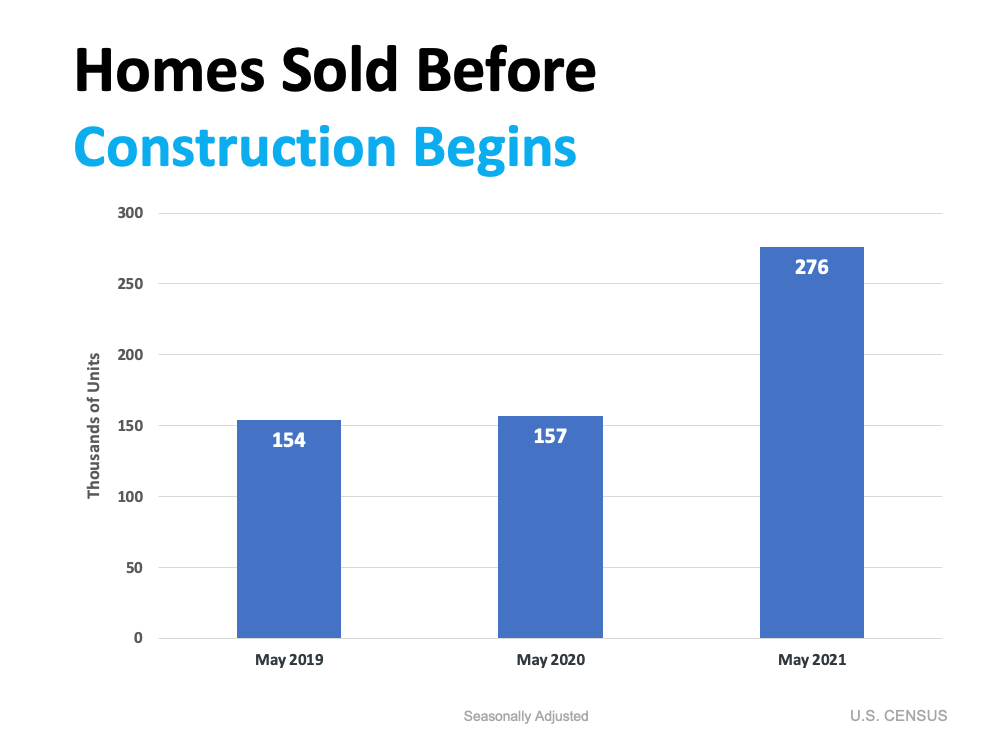
This insight that there's also an uptick in single-family homes permitted serves as an additional sign that more new homes lie ahead. It's important to realize that the construction doesn't have to start on these homes before you may be able to purchase one. According to the Monthly New Residential Sales report from the U.S. Census Bureau, many new homes are selling before construction even begins (see graph below):Home
Builders Ramp Up Construction Based on Demand | MyKCMThese signs are all good news for housing inventory. And as the recent challenges of rising lumber prices and dwindling lumber supply begin to improve, builders will be able to increase their production even more in the months ahead.

Bottom Line

While the inventory challenges we're facing today won't be solved overnight, the increase in new-home construction means your house may have more competition in the market. Let's connect to talk about finding your dream home and the newly built homes available in our area.


Posted in Market Updates
July 2, 2021

Happy Independence Day!?

Happy Independence Day!

Happy Independence Day! |
MyKCM

Wishing you a happy and safe Independence Day.


Posted in Market Updates
July 1, 2021

Are We in a Housing Bubble? Experts Say No.?

Are We in a Housing Bubble? Experts Say No.

Are We in a Housing Bubble?
Experts Say No. | MyKCM

The question of whether the real estate market is a bubble ready to pop seems to be dominating a lot of conversations – and everyone has an opinion. Yet, when it comes down to it, the opinions that carry the most weight are the ones based on experience and expertise.

Here are four expert opinions from professionals and organizations that have devoted their careers to giving great advice to the housing industry.

The Joint Center for Housing Studies in their The State of the Nation's Housing 2021 report:

… conditions today are quite different than in the early 2000s, particularly in terms of credit availability. The current climb in house prices instead reflects strong demand amid tight supply, helped along by record-low interest rates.

Nathaniel Karp, Chief U.S. Economist at BBVA:

The housing market is in line with fundamentals as interest rates are attractive and incomes are high due to fiscal stimulus, making debt servicing relatively affordable and allowing buyers to qualify for larger mortgages. Underwriting standards are still strong, so there is little risk of a bubble developing.

Bill McBride of Calculated Risk:

It's not clear at all to me that things are going to slow down significantly in the near future. In 2005, I had a strong sense that the hot market would turn and that, when it turned, things would get very ugly. Today, I don't have that sense at all, because all of the fundamentals are there. Demand will be high for a while, because Millennials need houses. Prices will keep rising for a while, because inventory is so low.

Mark Fleming, Chief Economist at First American:

Looking back at the bubble years, house prices exceeded house-buying power in 2006 nationally, but today house-buying power is nearly twice as high as the median sale price nationally…

Many find it hard to believe, but housing is actually undervalued in most markets and the gap between house-buying power and sale prices indicates there's room for further house price growth in the months to come.

Bottom Line

All four strongly believe that we're not in a bubble and won't see crashing home values as we did in 2008. And they're not alone – Goldman Sachs, JP Morgan, Morgan Stanley, and Merrill Lynch share the same opinion.


Posted in Market Updates