That House That’s Been Sitting Could Be Your Best Shot at a Deal

BLOGJune 22, 2026


Open up a home search and you'll see them. Listings that have been on the market for two months. Three. Some longer.

Most buyers scroll right past them, assuming something’s wrong with the house. But that instinct could be costing you, since the longer a home sits, the more motivated the seller usually gets.

Where Some Buyers Are Finding Better Deals

If affordability has been your #1 hurdle to buying, here’s a surprisingly simple strategy that could help you finally get your foot in the door. Start with the homes that have been sitting the longest. That’s often where the best deals are.

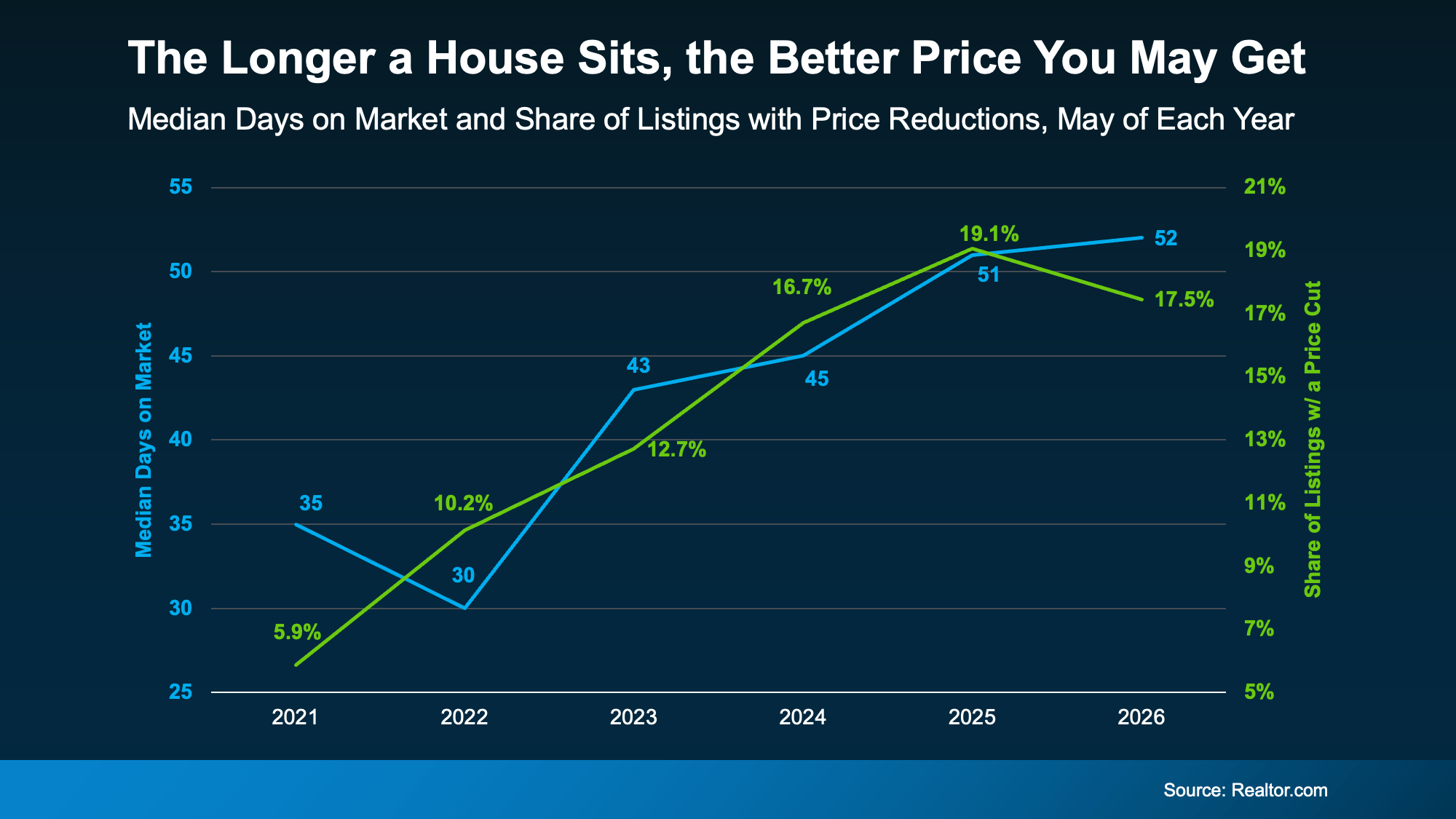
Here’s why. Data from Realtor.com shows there’s a connection between longer time on the market and lower sales prices. Basically, the longer a house sits, the more likely it is that the seller will reduce the price (see graph below):

a graph with numbers and lines

The blue line tracks how long homes stay on the market, while the green line tracks the share of homes getting a price reduction. As one climbs, so does the other.  

And if you focus on these homes that are just sitting and waiting, the opportunity for you is bigger than you may think right now.

Redfin data shows there’s $347 billion worth of stale listings on the market right now – more than ever before for this time of year. So, ask your agent to filter listings for you from oldest to newest. The home that fits your budget might already be there. Just further down the list than you thought.

Lingering Doesn’t Always Mean Something’s Wrong 

Let’s say you do that and something catches your eye. Still, you might be questioning why the home has been sitting in the first place. Just remember, sometimes it has nothing to do with the home itself.

According to Redfin, common causes are:

  • The asking price was set too high to start

  • The home didn’t show well online

  • There are a lot of homes for sale in the area, so it just got buried

So, nothing that’s necessarily a dealbreaker, or even anything that’s wrong with the home itself. If there’s a real issue, a thorough inspection will surface it. And that’s information you can use to negotiate. Not a reason to assume it’s a house worth skipping over.

How To Turn a Lingering Listing into a Win

So how do you capitalize on a lingering listing? According to USA Today, you have two main levers to pull.

The first is price. Work with your agent to study what comparable homes recently sold for, then build an offer around that. Coming in below asking price is fair game when a home has been sitting.

The second is concessions. If a seller won’t budge much on price, they may still help in other ways, like covering some closing costs, repair credits, or even a mortgage rate buydown that lowers your monthly payment.

A local agent has the context to tell which homes are the real opportunities and which are skippable.

Bottom Line

A house sitting on the market isn’t always a glaring red flag. In today’s market, it may be your best opportunity yet.

For help deciding which lingering listings are actually worth a second look, let’s connect.

The information contained, and the opinions expressed, in this article are not intended to be construed as investment advice. Keeping Current Matters, Inc. does not guarantee or warrant the accuracy or completeness of the information or opinions contained herein. Nothing herein should be construed as investment advice. You should always conduct your own research and due diligence and obtain professional advice before making any investment decision. Keeping Current Matters, Inc. will not be liable for any loss or damage caused by your reliance on the information or opinions contained herein.

March 4, 2022

Supply and Demand in Today's Market [INFOGRAPHIC]?

Supply and Demand in Today's Market [INFOGRAPHIC]

Supply and Demand in Today's
Market [INFOGRAPHIC] | MyKCM

Some Highlights

  • Today's housing market is the direct result of low supply and high buyer demand. Here's what that means for you and your plans to buy or sell.
  • For buyers, expect competition, be ready to move fast, and be prepared to submit your strongest offer. For sellers, know your house will be the center of attention and that it'll likely sell quickly and get multiple offers.
  • If you're ready to move, let's connect to talk about our local area and how you can take advantage of today's unprecedented housing market.
Posted in Market Updates
March 3, 2022

Are Home Prices Continuing To Rise?

Are Home Prices Continuing To Rise?

Are Home Prices Continuing To
Rise? | MyKCM

Many analysts projected home price appreciation would slow dramatically in the fall of 2021 and then continue to soften throughout 2022. So far, that hasn't happened. The major price indices are all revealing ongoing double-digit price appreciation. Here's a look at their reports on year-over-year price appreciation for December:

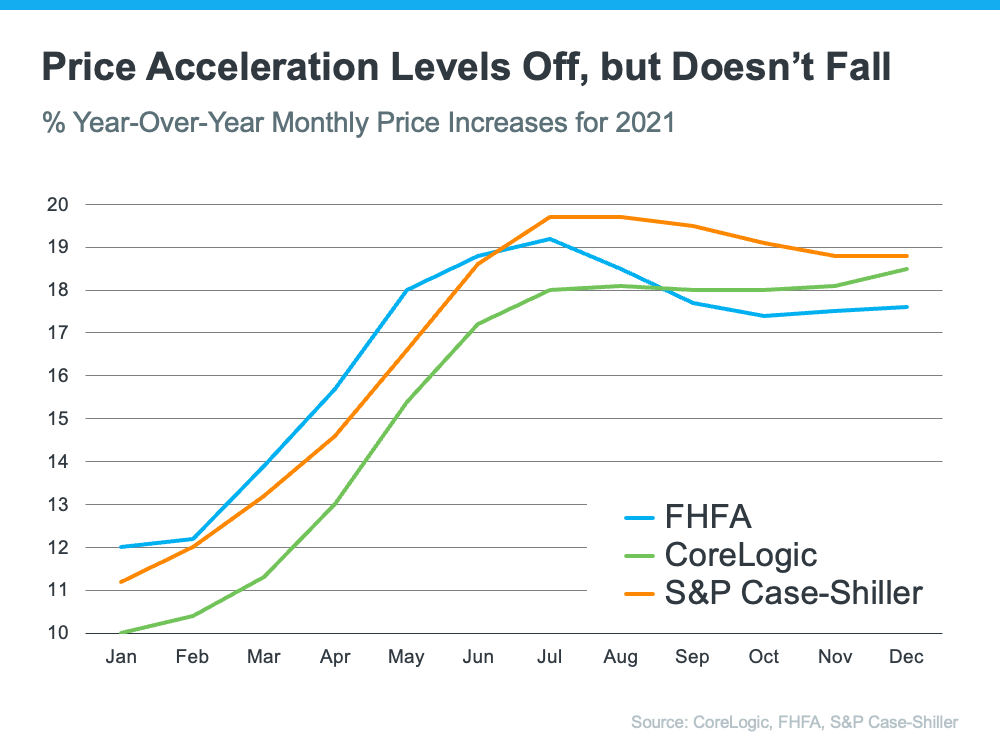
To show that they're not seeing signs of softening, here's a graph that gives the progression of all three indices for each month of 2021.

Are
Home Prices Continuing To Rise? | MyKCM

As the graph above reveals, last year, home price appreciation accelerated dramatically from January to July according to all three indices. Then, it began to decelerate in August when prices appreciated at a slower pace, but it didn't decline. Many thought that would be the beginning of a rapid slowdown in the level of home price appreciation, but as the data shows, that wasn't the case. Instead, prices began to level off for a few months before two of the three indices saw appreciation re-accelerate again in December.

To clarify, deceleration is not the same as depreciation. Acceleration means prices rise at a greater year-over-year pace than the previous month. Deceleration means home values continue to rise but at a slower pace of year-over-year appreciation. Depreciation means prices drop below current values. No one is forecasting that to happen.

In fact, the FHFA revealed that price appreciation accelerated in December in six of the nine regions it tracks. Case Shiller showed that appreciation accelerated in 15 of the 20 metros they report on. As Selma Hepp, Deputy Chief Economist at CoreLogicexplains:

After some signs of slowing home price growth . . . monthly price growth re-accelerated again, indicating home buyers have not yet thrown in the towel.

What Does This Mean for You?

Whether you're a first-time purchaser or someone looking to sell your current house and buy a home that better fits your needs, waiting to decide what to do will cost you in two ways:

  1. Mortgage rates are forecast to rise this year.
  2. Home prices should continue to appreciate at double-digit levels for some time.

If you wait, rising mortgage rates and high home price appreciation will have a dramatic impact on your monthly mortgage payment.

Bottom Line

Maybe the best thing to do is listen to the advice of Len Kiefer, Deputy Chief Economist at Freddie Mac:

If you're thinking about waiting until next year and that maybe rates are higher, but you'll get a deal on prices – well that's risky. It may be more advantageous to purchase this year relative to waiting until 2023 at this time.


Posted in Market Updates
March 1, 2022

An Expert Advisor Will Give You the Best Advice in Today's Market?

An Expert Advisor Will Give You the Best Advice in Today's Market

An Expert Advisor Will Give
You the Best Advice in Today's Market | MyKCM

Having an experienced guide coaching you through the process of buying or selling a home is important in a normal market – but today's market is far from normal. As a result, an expert real estate advisor isn't just good to have by your side, they're essential.

Today's housing market is full of extremes. Experts project mortgage rates will continue to rise this year, and that's driving significant demand for homes as buyers want to make their purchases before rates climb even higher. At the same time, an absence of sellers is leading to record-low housing inventory. This imbalance in supply and demand is creating bidding wars and driving home price appreciation as well as considerable gains in home equity.

These market conditions can feel overwhelming, but you don't have to go at it alone. Having a trusted expert to coach you through the process of buying or selling a home gives you clarity and confidence through each step.

Here are just a few of the ways a real estate expert is invaluable:

Contracts – Agents help with the disclosures and contracts necessary in today's heavily regulated environment.

Experience – In an unprecedented market, experience is crucial. Real estate professionals know the entire sales process, including how it's changed over the past two years.

Negotiations – Your real estate advisor acts as a buffer in negotiations with all parties throughout the entire transaction and advocates for your best interests.

Education – Knowledge is power in today's market, and your advisor will simply and effectively explain market conditions and translate what they mean for you.

Pricing – Finally, a real estate professional understands today's real estate values when setting the price of your home or helping you make an offer to purchase one.

A real estate agent is a crucial guide through this unprecedented market, but not all agents are created equal. A true expert can carefully walk you through the whole real estate process, look out for your unique needs, and advise you on the best ways to achieve success. Finding an expert real estate advisor – not just any agent – should be your top priority when you're ready to buy or sell a home.

What's the key to choosing the right expert?

It starts with trust. You'll want to know you can trust the advice they're giving you, so you need to make sure you're connected with a true professional. No one can provide perfect advice because it's impossible to know exactly what's going to happen at every turn – especially in today's unique market. But a true professional can give you the best possible advice based on the information and situation at hand. They'll help you make the necessary adjustments along the way, advocate for you throughout the process, and coach you on the essential knowledge you need to make confident decisions. That's exactly what you want and deserve.

Bottom Line

It's critical to have an expert on your side who's well versed in navigating today's rapidly changing market. If you're planning to buy or sell a home this year, let's connect so you have a real estate professional on your side to give you the best advice and guide you along the way.


Posted in Market Updates
Feb. 25, 2022

The Difference Between Renting and Owning [INFOGRAPHIC]?

The Difference Between Renting and Owning [INFOGRAPHIC]

The Difference Between
Renting and Owning [INFOGRAPHIC] | MyKCM

Some Highlights

  • If you're deciding whether to rent or buy, consider the many financial benefits that come with owning a home.
  • As a renter, you build your landlord's wealth and face rising costs. As a homeowner, you build your own net worth and can lock in your monthly payments for the length of your loan.
  • If you're weighing your options, remember that owning a home is a decision that has considerable financial perks. If you want to learn more, let's connect to talk about the perks of homeownership.
  •  
Posted in Market Updates
Feb. 24, 2022

The #1 Reason To Sell Your House Today?

The #1 Reason To Sell Your House Today

The #1 Reason To Sell Your
House Today | MyKCM

Almost every industry is currently struggling with supply chain disruptions. This also applies to the current U.S. housing market, where buyer demand far exceeds housing supply.

Purchaser demand is very strong right now. The National Association of Realtors (NAR) just released their latest Existing Home Sales Report which reveals that sales surged in January. Existing home sales rose to a seasonally adjusted annual rate of 6.5 million – an increase of 6.7% from the prior month, with sales up in all regions. However, there's one big challenge.

Inventory Is at an All-Time Low

Because purchaser demand is so high, the market is running out of available homes for sale. The above-mentioned report states that the current months' supply of inventory of homes for sale has fallen to 1.6 months. This prompts Lawrence Yun, Chief Economist at NAR, to say:

The inventory of homes on the market remains woefully depleted, and in fact is currently at an all-time low.

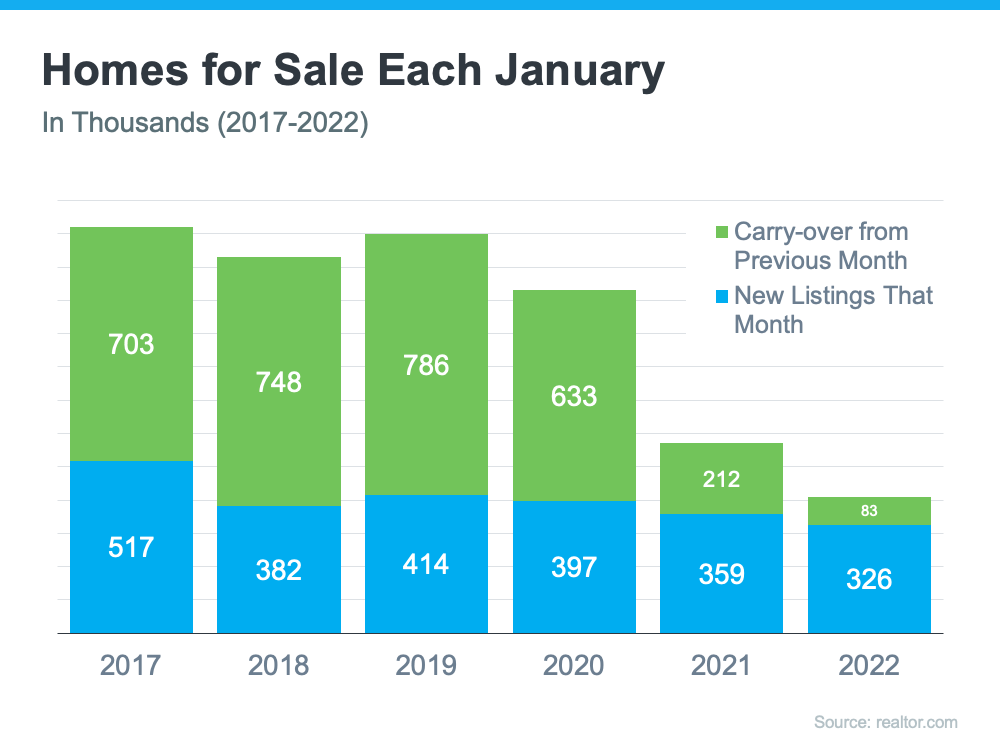
Earlier this month, realtor.com released their inventory data for January. It helps confirm this point. Here's a graph comparing inventory levels for January over the last six years:

The
#1 Reason To Sell Your House Today | MyKCM

As the graph shows, new listings coming on the market have decreased over the last four years (shown in blue in the graph). The graph also reveals that carry-over inventory has plummeted in recent years. This is because listings are now sold so quickly, they don't stay on the market long enough to carry over month-to-month (shown in green in the graph). In other words, homes are not staying on the market for months as they had prior to the pandemic. In the report mentioned above, NAR reveals that:

Seventy-nine percent of homes sold in January 2022 were on the market for less than a month.

Odeta Kushi, Deputy Chief Economist at First Americanexplains it like this:

A higher velocity of sales (lower [Days on Market]) helps to explain a housing market characterized by both higher sales & lower inventory. Many resale transactions are happening so quickly that they ‘flow' in & then out of the ‘stock' between the fixed monthly measurement of inventory.

What Does This Mean for Sellers?

Anyone thinking of putting their home on the market shouldn't wait. A seller will always negotiate the best deal when demand is high and supply is limited. That's exactly the situation in the real estate market today.

Later this year, inventory (and by extension, your competition) will increase as many homeowners are waiting to put their homes on the market in the spring and early summer.

In addition, Len Kiefer, Deputy Chief Economist at Freddie Macsays:

Housing starts start off 2022 strong, just edging out 2021 for most in January since 2006.

As these newly built homes are completed, they will also become competition for your house. This gives you a tremendous opportunity right now. Don't wait for that increase in competition in your area. If you want to sell in 2022 and are ready to start the process, today is the day to list your house.

Bottom Line

If you're ready to sell, let's connect to get your house on the market while today's inventory situation is in your favor.


Posted in Market Updates
Feb. 23, 2022

How Supply and Demand Can Impact Your Buying and Selling Goals

How Supply and Demand Can Impact Your Buying and Selling Goals

How Supply and Demand Can
Impact Your Buying and Selling Goals | MyKCM

In today's housing market, there are far more buyers looking for homes than sellers listing their houses. Based on the concept of supply and demand, this means home prices will naturally rise. Why is that? When there are more people trying to buy an item than there are making that item available for sale, that drives prices up. And that's exactly the case in today's housing market. So, knowing what's happening with the inventory of homes for sale and the demand for housing is crucial for today's buyers and sellers.

Nationally, Demand Is High and Supply Is Very Low

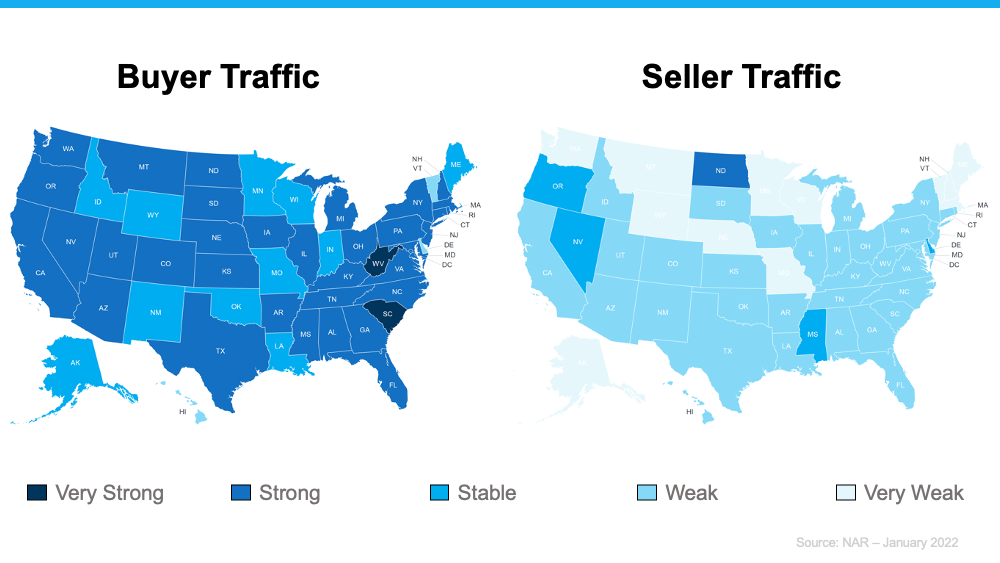
The latest buyer and seller activity data from the National Association of Realtors (NAR) indicates buyer traffic heavily outweighs seller traffic today, as shown in the maps below. There are far darker blues (strong buyer activity) on the left and much lighter blues (weak seller activity) on the right. In other words, this shows how the demand for homes is significantly greater than what's available to purchase.

How
Supply and Demand Can Impact Your Buying and Selling Goals | MyKCM

What Does This Mean if You're a Seller?

Supply is struggling to keep pace with demand. In fact, the inventory of homes for sale recently hit an all-time low. That gives you an incredible advantage when you sell your house. With so few listings, it's likely more potential buyers will view your house – especially if you work with an agent to price it right. That means there's a high chance you'll receive multiple offers or buyers will enter a bidding war for your house. And that dynamic can drive the sale price of your home up.

What Does This Mean if You're a Buyer?

As a buyer with fewer options available, you're likely to see more competition, so you need to be strategic to win. First, make sure you have a trusted professional on your side. Your real estate agent will help you understand your local market and work with you to act quickly when the time is right. Even when it's challenging to find a home, you can still succeed as a buyer today if you have a trusted advisor on your side every step of the way.

Bottom Line

Whether you're a homebuyer, seller, or both, knowledge truly is power. Let's connect today so you can better understand what's happening in our local market and achieve your homebuying and selling goals this year.


Posted in Market Updates
Feb. 22, 2022

The Perks of Owning More Than One Home?

The Perks of Owning More Than One Home

The Perks of Owning More Than
One Home | MyKCM

Many things have changed over the past couple of years, and real estate is no exception. One impact is an increased desire to own more than one home. According to the recent Luxury Market Report from Luxury Home Marketing:

As trends such as remote working and flexi-hours took hold in 2021, so too did the flexibility of relocating as well as the growth of second homeownership.

This may be because the pandemic has altered how we think about our homes. Where we live has become, more than ever, our safe space and our getaway. And with the rise in remote work, more people are reconsidering where they want to live and buying second homes to give them greater flexibility. If you fall in that category, here are just a few of the perks you'll enjoy, and how owning a second home may be a great decision for your lifestyle and your future.

Enjoy a Change in Scenery (or Weather)

When you have two homes, you can alternate between them as the weather changes or as you crave different scenery. Do you want to live in an area with a particular season? Would alternating between a resort and a suburban setting be ideal? With two homes, you have those options. Being able to move between homes based on which location best suits you at the time gives you added flexibility and variety that can help increase your happiness.

Build Your Wealth Faster

You may have heard that home equity is skyrocketing, thanks to ongoing home price appreciation. CoreLogic reports that the average homeowner gained $56,700 in equity over the last year. With home prices projected to continue rising, if you purchase a second home, you could benefit from rising equity on both properties to build your wealth (and your net worth) even faster.

Be Closer to Loved Ones

The pandemic has also reignited the importance of being near our loved ones. One option worth exploring is whether you want your second home to be near the people who matter most in your life. This makes it easier to see your loved ones but still gives you your own dedicated, private space so you can be nearby for major life events or longer visits.

Lock in Your Expenses

Buying a second home today and locking in your mortgage rate may be a good option if you're looking to stabilize your housing costs for the long haul. If you're approaching retirement or are looking to use your second home as your permanent residence in the future, buying that house now with today's rate and price may be a good financial decision. That way, no matter what happens with rates and prices in years ahead, your monthly payment is locked in for the next 15-30 years.

Bottom Line

Having multiple homes has considerable benefits. If owning a second home is something you're interested in, let's connect to explore your options, discuss the benefits, and take the next step to start your home search.

Posted in Market Updates
Feb. 21, 2022

Real Estate Voted the Best Investment Eight Years in a Row?

Real Estate Voted the Best Investment Eight Years in a Row

Real Estate Voted the Best
Investment Eight Years in a Row | MyKCM

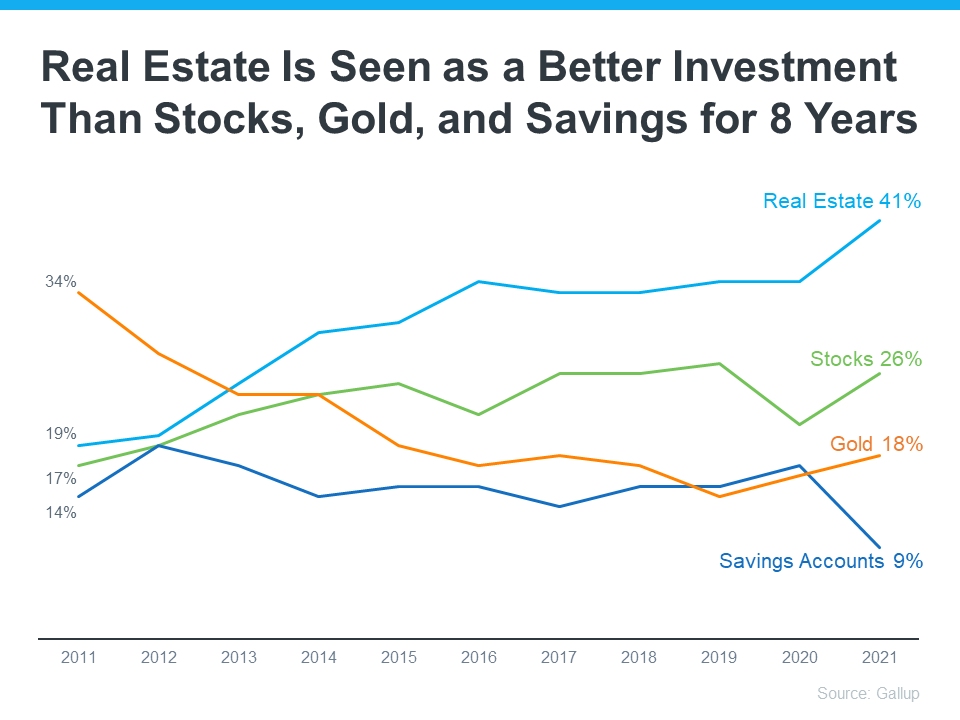
In an annual Gallup poll, Americans chose real estate as the best long-term investment. And it's not the first time it's topped the list, either. Real estate has been on a winning streak for the past eight years, consistently gaining traction as the best long-term investment (see graph below):

Real
Estate Voted the Best Investment Eight Years in a Row | MyKCMIf you're thinking about purchasing a home this year, this poll should reassure you. Even when inflation is rising like it is today, Americans agree an investment like real estate truly shines.

Why Is Real Estate a Great Investment During Times of High Inflation?

With inflation reaching its highest level in 40 years, it's more important than ever to understand the financial benefits of homeownership. Rising inflation means prices are increasing across the board. That includes goods, services, housing costs, and more. But when you purchase your home, you lock in your monthly housing payments, effectively shielding yourself from increasing housing payments. James Royal, Senior Wealth Management Reporter at Bankrateexplains it like this:

A fixed-rate mortgage allows you to maintain the biggest portion of housing expenses at the same payment. Sure, property taxes will rise and other expenses may creep up, but your monthly housing payment remains the same.

If you're a renter, you don't have that same benefit, and you aren't protected from increases in your housing costs, especially rising rents.

History Shows During Inflationary Periods, Home Prices Rise as Well

As a homeowner, your house is an asset that typically increases in value over time, even during inflation. That‘s because, as prices rise, the value of your home does, too. And that makes buying a home a great hedge during periods of high inflation. Natalie Campisi, Advisor Staff for Forbesnotes:

Tangible assets like real estate get more valuable over time, which makes buying a home a good way to spend your money during inflationary times.

Bottom Line

Housing truly is a strong investment, especially when inflation is high. When you lock in a mortgage payment, you're shielded from housing cost increases, and you own an asset that typically gains value with time. If you want to better understand how buying a home could be a great investment for you, let's connect today.


Posted in Market Updates
Feb. 18, 2022

What's Driving Today's High Buyer Demand? [INFOGRAPHIC]?

What's Driving Today's High Buyer Demand? [INFOGRAPHIC]

What's Driving Today's High
Buyer Demand? [INFOGRAPHIC] | MyKCM

Some Highlights

  • There's an influx of buyers looking for homes today, and that means your house is in high demand. Here are a few reasons why so many people are looking to buy a home.
  • Buyers are motivated to beat rising mortgage rates, and many want to escape rising rents. There's also additional demand from millennials who are reaching peak homebuying age.
  • If you're thinking about selling your house, today's demand is great news. Let's connect to begin the process of listing your house while buyers are ready to purchase.
  •  
Posted in Market Updates
Feb. 17, 2022

4 Simple Graphs Showing Why This Is Not a Housing Bubble?

4 Simple Graphs Showing Why This Is Not a Housing Bubble

4 Simple Graphs Showing Why
This Is Not a Housing Bubble | MyKCM

recent survey revealed that many consumers believe there's a housing bubble beginning to form. That feeling is understandable, as year-over-year home price appreciation is still in the double digits. However, this market is very different than it was during the housing crash 15 years ago. Here are four key reasons why today is nothing like the last time.

1. Houses Are Not Unaffordable Like They Were During the Housing Boom

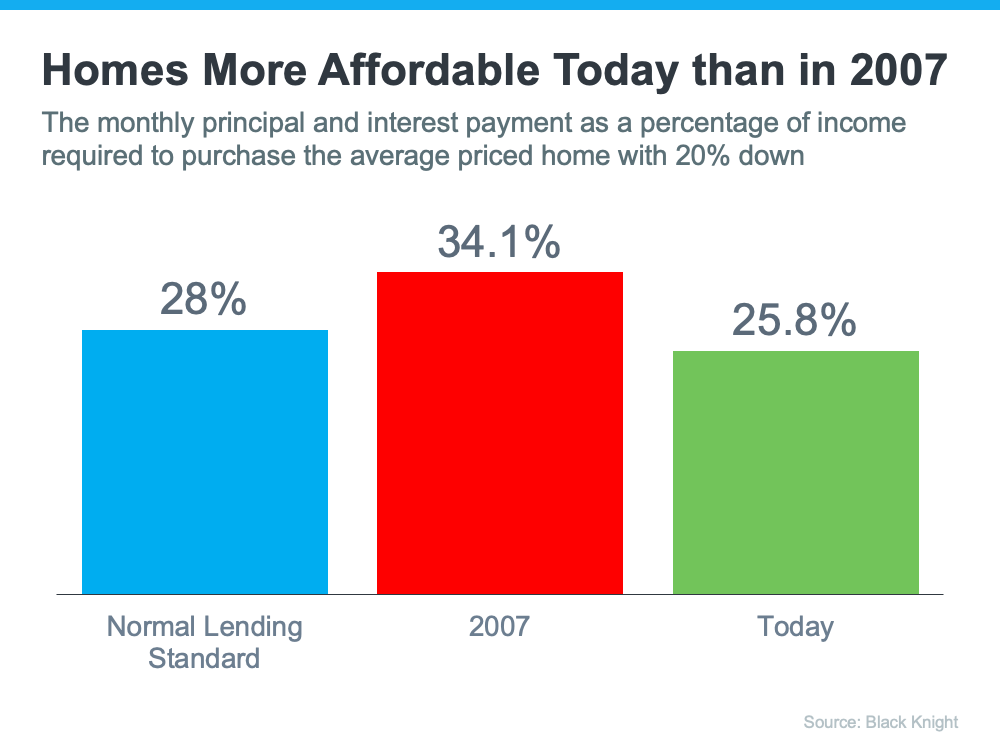
The affordability formula has three components: the price of the home, wages earned by the purchaser, and the mortgage rate available at the time. Conventional lending standards say a purchaser should not spend more than 28% of their gross income on their mortgage payment.

Fifteen years ago, prices were high, wages were low, and mortgage rates were over 6%. Today, prices are still high. Wages, however, have increased, and the mortgage rate, even after the recent spike, is still well below 6%. That means the average purchaser today pays less of their monthly income toward their mortgage payment than they did back then.

In the latest Affordability Report by ATTOM Data, Chief Product Officer Todd Teta addresses that exact point:

The average wage earner can still afford the typical home across the U.S., but the financial comfort zone continues shrinking as home prices keep soaring and mortgage rates tick upward.

Affordability isn't as strong as it was last year, but it's much better than it was during the boom. Here's a chart showing that difference:

4
Simple Graphs Showing Why This Is Not a Housing Bubble | MyKCM

If costs were so prohibitive, how did so many homes sell during the housing boom?

2. Mortgage Standards Were Much More Relaxed During the Boom

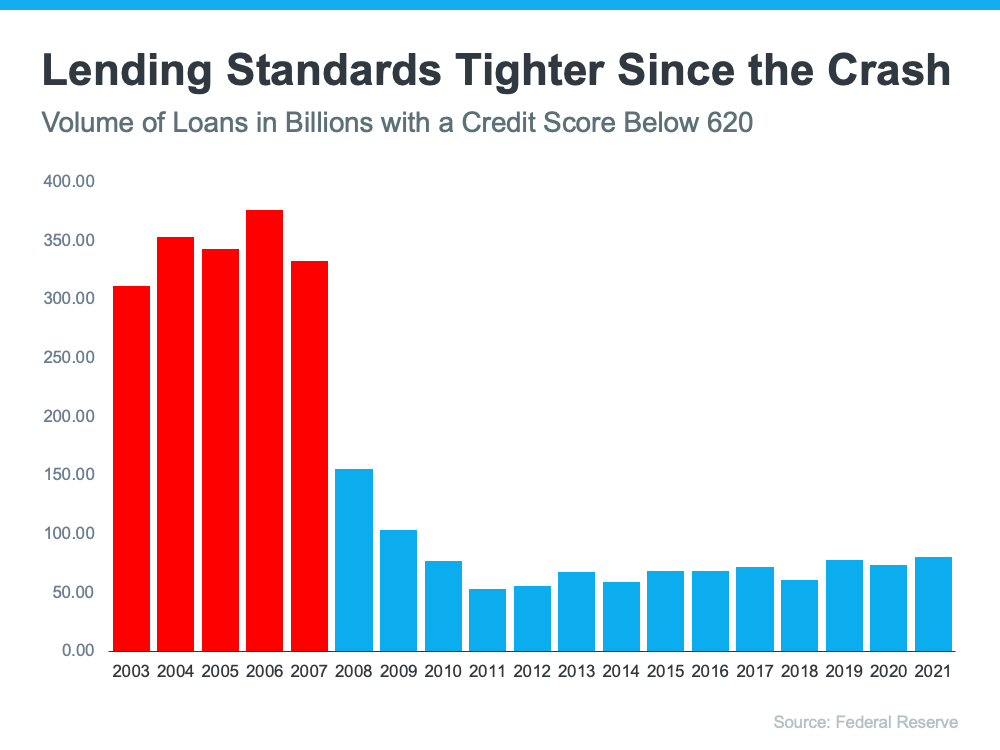
During the housing bubble, it was much easier to get a mortgage than it is today. As an example, let's review the number of mortgages granted to purchasers with credit scores under 620. According to credit.org, a credit score between 550-619 is considered poor. In defining those with a score below 620, they explain:

Credit agencies consider consumers with credit delinquencies, account rejections, and little credit history as subprime borrowers due to their high credit risk.

Buyers can still qualify for a mortgage with a credit score that low, but they're considered riskier borrowers. Here's a graph showing the mortgage volume issued to purchasers with a credit score less than 620 during the housing boom, and the subsequent volume in the 14 years since.

4
Simple Graphs Showing Why This Is Not a Housing Bubble | MyKCM

Mortgage standards are nothing like they were the last time. Purchasers that acquired a mortgage over the last decade are much more qualified. Let's take a look at what that means going forward.

3. The Foreclosure Situation Is Nothing Like It Was During the Crash

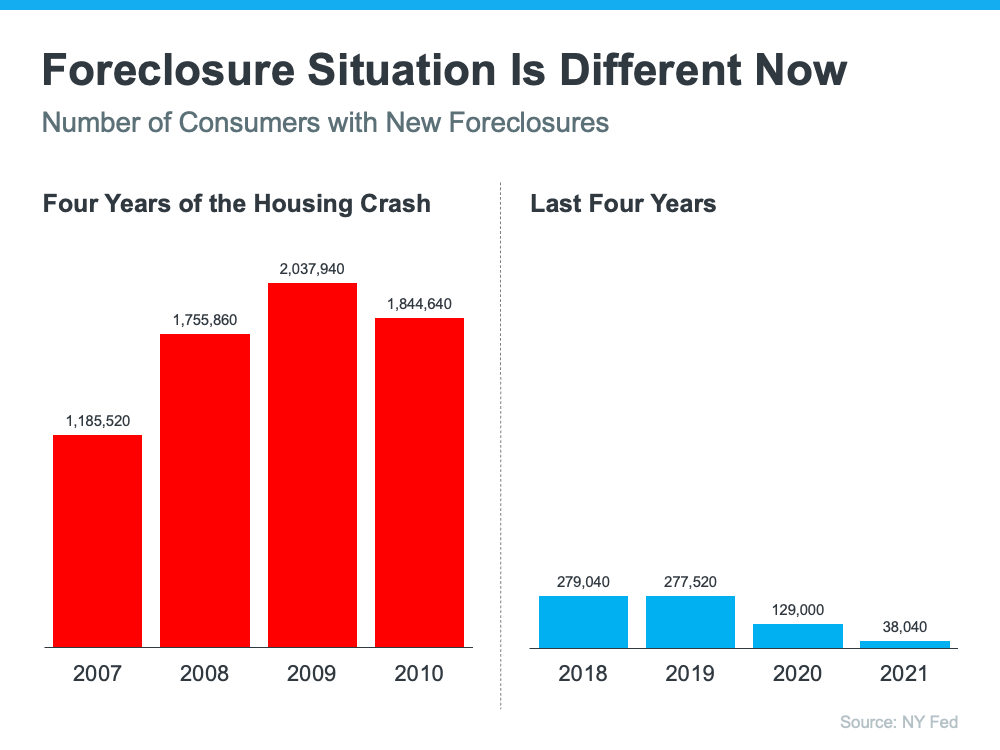
The most obvious difference is the number of homeowners that were facing foreclosure after the housing bubble burst. The Federal Reserve issues a report showing the number of consumers with a new foreclosure notice. Here are the numbers during the crash compared to today:

4
Simple Graphs Showing Why This Is Not a Housing Bubble | MyKCM

There's no doubt the 2020 and 2021 numbers are impacted by the forbearance program, which was created to help homeowners facing uncertainty during the pandemic. However, there are fewer than 800,000 homeowners left in the program today, and most of those will be able to work out a repayment plan with their banks.

Rick Sharga, Executive Vice President of RealtyTracexplains:

The fact that foreclosure starts declined despite hundreds of thousands of borrowers exiting the CARES Act mortgage forbearance program over the last few months is very encouraging. It suggests that the ‘forbearance equals foreclosure' narrative was incorrect.

Why are there so few foreclosures now? Today, homeowners are equity rich, not tapped out.

In the run-up to the housing bubble, some homeowners were using their homes as personal ATM machines. Many immediately withdrew their equity once it built up. When home values began to fall, some homeowners found themselves in a negative equity situation where the amount they owed on their mortgage was greater than the value of their home. Some of those households decided to walk away from their homes, and that led to a rash of distressed property listings (foreclosures and short sales), which sold at huge discounts, thus lowering the value of other homes in the area.

Homeowners, however, have learned their lessons. Prices have risen nicely over the last few years, leading to over 40% of homes in the country having more than 50% equity. But owners have not been tapping into it like the last time, as evidenced by the fact that national tappable equity has increased to a record $9.9 trillion. With the average home equity now standing at $300,000, what happened last time won't happen today.

As the latest Homeowner Equity Insights report from CoreLogic explains:

Not only have equity gains helped homeowners more seamlessly transition out of forbearance and avoid a distressed sale, but they've also enabled many to continue building their wealth.

There will be nowhere near the same number of foreclosures as we saw during the crash. So, what does that mean for the housing market?

4. We Don't Have a Surplus of Homes on the Market – We Have a Shortage

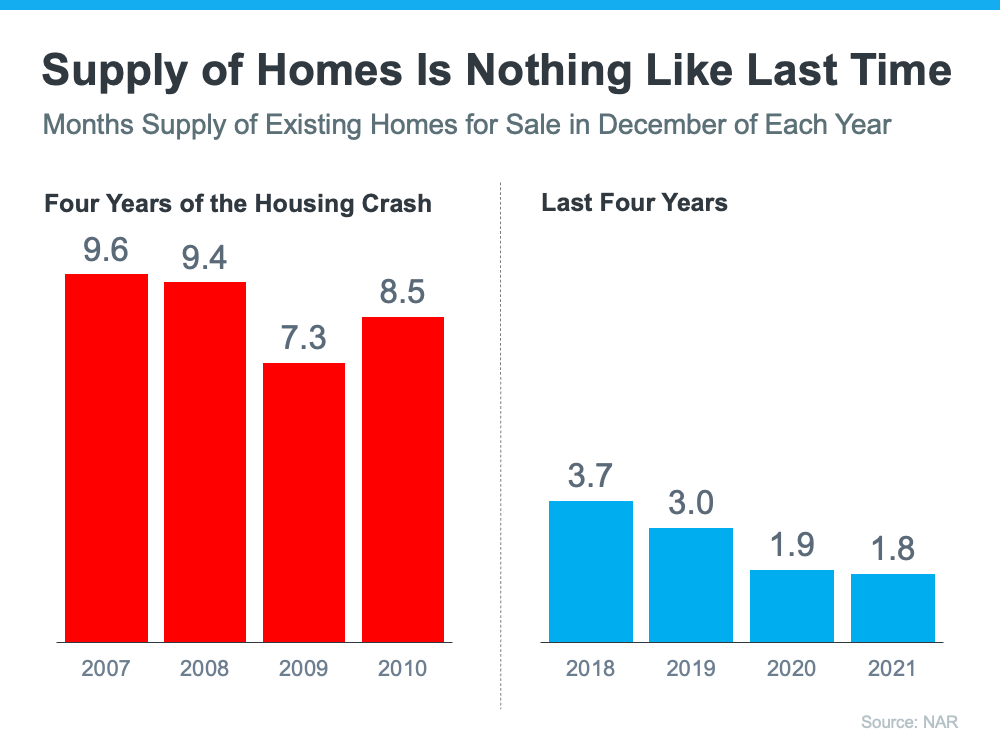
The supply of inventory needed to sustain a normal real estate market is approximately six months. Anything more than that is an overabundance and will causes prices to depreciate. Anything less than that is a shortage and will lead to continued price appreciation. As the next graph shows, there were too many homes for sale from 2007 to 2010 (many of which were short sales and foreclosures), and that caused prices to tumble. Today, there's a shortage of inventory, which is causing the acceleration in home values to continue.

4
Simple Graphs Showing Why This Is Not a Housing Bubble | MyKCM

Inventory is nothing like the last time. Prices are rising because there's a healthy demand for homeownership at the same time there's a shortage of homes for sale.

Bottom Line

If you're worried that we're making the same mistakes that led to the housing crash, the graphs above show data and insights to help alleviate your concerns.


Posted in Market Updates