That House That’s Been Sitting Could Be Your Best Shot at a Deal

BLOGJune 22, 2026


Open up a home search and you'll see them. Listings that have been on the market for two months. Three. Some longer.

Most buyers scroll right past them, assuming something’s wrong with the house. But that instinct could be costing you, since the longer a home sits, the more motivated the seller usually gets.

Where Some Buyers Are Finding Better Deals

If affordability has been your #1 hurdle to buying, here’s a surprisingly simple strategy that could help you finally get your foot in the door. Start with the homes that have been sitting the longest. That’s often where the best deals are.

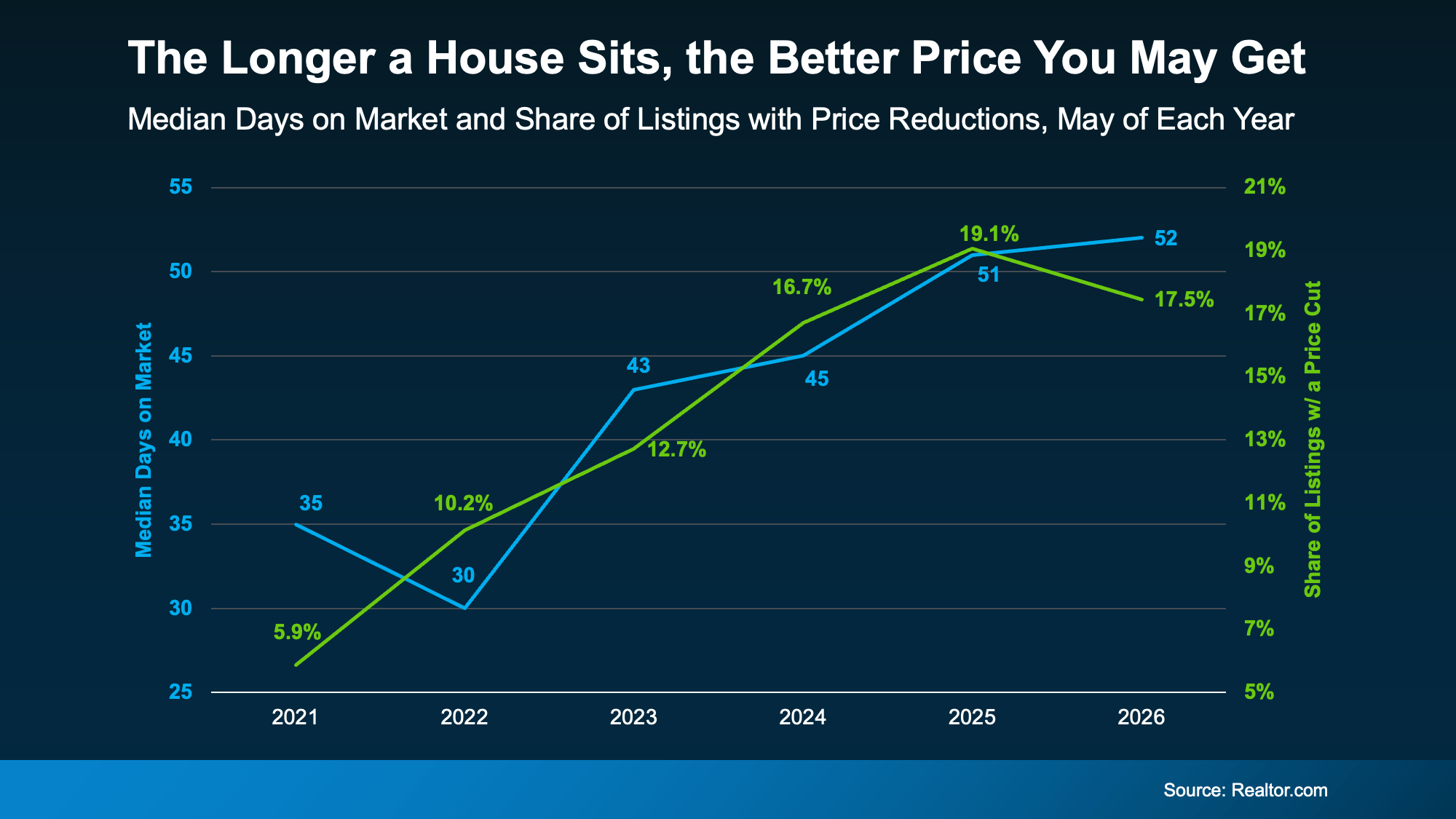
Here’s why. Data from Realtor.com shows there’s a connection between longer time on the market and lower sales prices. Basically, the longer a house sits, the more likely it is that the seller will reduce the price (see graph below):
a graph with numbers and lines

The blue line tracks how long homes stay on the market, while the green line tracks the share of homes getting a price reduction. As one climbs, so does the other.  

And if you focus on these homes that are just sitting and waiting, the opportunity for you is bigger than you may think right now.

Redfin data shows there’s $347 billion worth of stale listings on the market right now – more than ever before for this time of year. So, ask your agent to filter listings for you from oldest to newest. The home that fits your budget might already be there. Just further down the list than you thought.

Lingering Doesn’t Always Mean Something’s Wrong 

Let’s say you do that and something catches your eye. Still, you might be questioning why the home has been sitting in the first place. Just remember, sometimes it has nothing to do with the home itself.

According to Redfin, common causes are:

  • The asking price was set too high to start

  • The home didn’t show well online

  • There are a lot of homes for sale in the area, so it just got buried

So, nothing that’s necessarily a dealbreaker, or even anything that’s wrong with the home itself. If there’s a real issue, a thorough inspection will surface it. And that’s information you can use to negotiate. Not a reason to assume it’s a house worth skipping over.

How To Turn a Lingering Listing into a Win

So how do you capitalize on a lingering listing? According to USA Today, you have two main levers to pull.

The first is price. Work with your agent to study what comparable homes recently sold for, then build an offer around that. Coming in below asking price is fair game when a home has been sitting.

The second is concessions. If a seller won’t budge much on price, they may still help in other ways, like covering some closing costs, repair credits, or even a mortgage rate buydown that lowers your monthly payment.

A local agent has the context to tell which homes are the real opportunities and which are skippable.

Bottom Line

A house sitting on the market isn’t always a glaring red flag. In today’s market, it may be your best opportunity yet.

For help deciding which lingering listings are actually worth a second look, let’s connect.

The information contained, and the opinions expressed, in this article are not intended to be construed as investment advice. Keeping Current Matters, Inc. does not guarantee or warrant the accuracy or completeness of the information or opinions contained herein. Nothing herein should be construed as investment advice. You should always conduct your own research and due diligence and obtain professional advice before making any investment decision. Keeping Current Matters, Inc. will not be liable for any loss or damage caused by your reliance on the information or opinions contained herein.

Nov. 18, 2022

Should You Update Your House Before You Sell? Ask a Real Estate Professional. [INFOGRAPHIC]?

Should You Update Your House Before You Sell? Ask a Real Estate Professional. [INFOGRAPHIC]

Should You Update Your
House Before You Sell? Ask a Real Estate Professional. [INFOGRAPHIC] | MyKCM

Some Highlights

  • You may be wondering what needs to be renovated before you sell your house. In today's shifting market, making your house appealing is more important than ever.
  • That's why it's essential to lean on a real estate professional who has in-depth knowledge of today's housing market. They know what buyers are looking for and how to highlight any upgrades you make.
  • Let's connect so you know where to focus your efforts so your house will stand out in a today's market.
  •  
Posted in Market Updates
Nov. 17, 2022

More People Are Finding the Benefits of Multigenerational Households Today?

More People Are Finding the Benefits of Multigenerational Households Today

More People Are Finding the
Benefits of Multigenerational Households Today | MyKCM

If you're thinking of buying a home and living with siblings, parents, or grandparents, then multigenerational living may be for you. The Pew Research Center defines a multigenerational household as a home with two or more adult generations. And the number of individuals choosing multigenerational living has increased over the past 50 years.

As you consider this option for your own home search, know it could help you on your homeownership journey and provide you with other incredible benefits along the way.

Living with Loved Ones Could Help You Achieve Your Homeownership Goals

There are several reasons people choose to live in a multigenerational household, and for many, the arrangement is a personal one. But according to the Pew Research Center, the top reason people choose to live together today is financial.

recent study from Freddie Mac also finds more people are choosing to buy a home together so they can save money in the homebuying process. As the study says:

. . . an increasing percentage of young adult first-time homebuyers are relying on support from older generations, including their parents, to buy a home together.

For these individuals, combining their resources can help them achieve their dream of buying and owning a home. By pooling their incomes together to make that purchase, they may be able to afford a home they couldn't on their own.

Other Key Benefits of Multigenerational Living

Not to mention, living in a home with loved ones can have other benefits too, like giving you more quality time to spend together. Darla Mercado, Certified Financial Planner and Markets Editor for CNBC.comexplains how this living arrangement can help on a personal and financial level:

Residing with relatives can offer advantages . . . you can pool multiple streams of income, for instance. And in households with young children, grandparents can pitch in with child care.

If this sounds like a great option for you, it's important to work with a trusted real estate professional to discuss your needs. They can help you navigate the process to find the right home for you and your loved ones.

Bottom Line

More people are discovering the benefits of multigenerational living. For the best information and help deciding what's right for your personal situation, let's connect and start the conversation today.


Posted in Market Updates
Nov. 16, 2022

Top Questions About Selling Your Home This Winter?

Top Questions About Selling Your Home This Winter

Top Questions About Selling
Your Home This Winter | MyKCM

There's no denying the housing market is undergoing a shift this season, and that may leave you with some questions about whether it still makes sense to sell your house. Here are three of the top questions you may be asking – and the data that helps answer them – so you can make a confident decision.

1. Should I Wait To Sell?

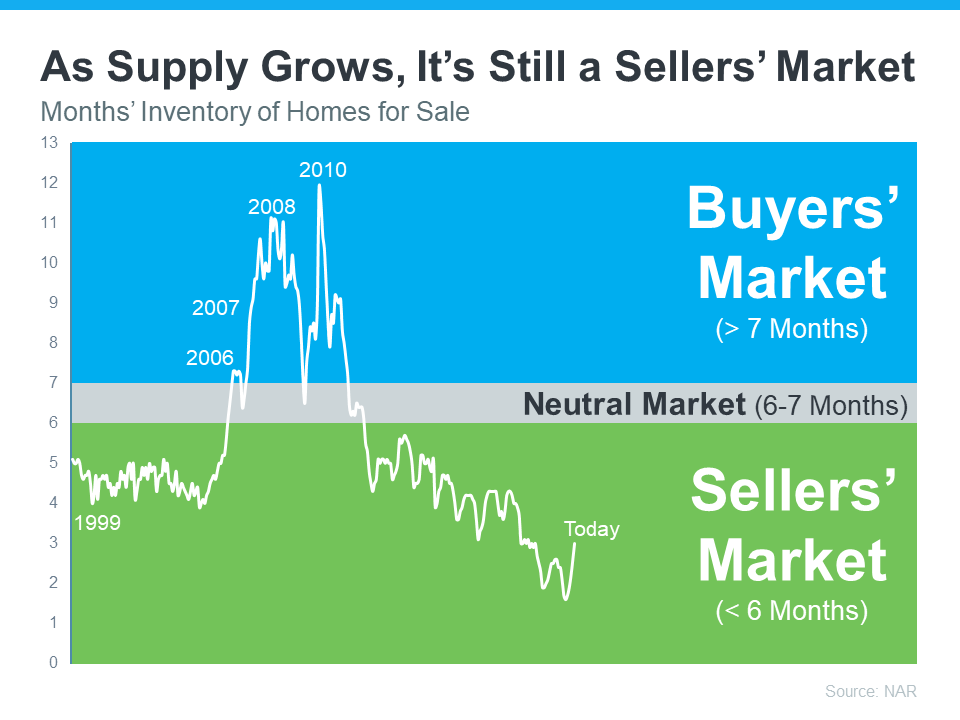
Even though the supply of homes for sale has increased in 2022, inventory is still low overall. That means it's still a sellers' market. The graph below helps put the inventory growth into perspective. Using data from the National Association of Realtors (NAR), it shows just how far off we are from flipping to a buyers' market:

Top Questions About Selling Your Home This Winter | MyKCM

While buyers have regained some negotiation power as inventory has grown, you haven't missed your window to sell. Your house could still stand out since inventory is low, especially if you list now while other sellers hold off until after the holiday rush and the start of the new year.

2. Are Buyers Still Out There?

If you're thinking of selling your house but are hesitant because you're worried buyer demand has disappeared in the face of higher mortgage rates, know that isn't the case for everyone. While demand has eased this year, millennials are still looking for homes. As an article in Forbes explains:

At about 80 million strong, millennials currently make up the largest share of homebuyers (43%) in the U.S., according to a recent National Association of Realtors (NAR) report. Simply due to their numbers and eagerness to become homeowners, this cohort is quite literally shaping the next frontier of the homebuying process. Once known as the ‘rent generation,' millennials have proven to be savvy buyers who are quite nimble in their quest to own real estate. In fact, I don't think it's a stretch to say they are the key to the overall health and stability of the current housing industry.

While the millennial generation has been dubbed the renter generation, that namesake may not be appropriate anymore. Millennials, the largest generation, are actually a significant driving force for buyer demand in the housing market today. If you're wondering if buyers are still out there, know that there are still people who are searching for a home to buy today. And your house may be exactly what they're looking for.

3. Can I Afford To Buy My Next Home?

If current market conditions have you worried about how you'll afford your next move, consider this: you may have more equity in your current home than you realize.

Homeowners have gained significant equity over the past few years and that equity can make a big difference in the affordability equation, especially with mortgage rates higher now than they were last year. According to Mark Fleming, Chief Economist at First American:

. . . homeowners, in aggregate, have historically high levels of home equity. For some of those equity-rich homeowners, that means moving and taking on a higher mortgage rate isn't a huge deal—especially if they are moving to a more affordable city.

Bottom Line

If you're thinking about selling your house this season, let's connect so you have the expert insights you need to make the best possible move today.


Posted in Market Updates
Nov. 15, 2022

Why It May Be Time To Add Newly Built Homes to Your Search?

Why It May Be Time To Add Newly Built Homes to Your Search

Why It May Be Time To Add
Newly Built Homes to Your Search | MyKCM

If you put a pause on your home search because you weren't sure where you'd go once you sold your house, it might be a good time to get back into the market. If you're willing to work with a trusted agent to consider a newly built home, you may have even more options and incentives than you realize. That may be why the National Association of Home Builders (NAHB) says the share of buyers looking for new construction is increasing:

According to the quarterly Housing Trends Report, the popularity of new construction homes is continuing to rebound . . .

Here's a few reasons more buyers may be drawn to newly built homes.

More Options To Choose from and Potential Builder Incentives

When looking for a home, you can choose between existing homes (those that are already built and previously owned) and newly constructed ones. While the inventory of existing homes has increased this year, it's still below more typical years like 2019. Currently, according to the National Association of Realtors (NAR), there is a 3.2-month supply at the current sales pace. For reference, a roughly 6-month supply is considered a balanced market, leaving us in a sellers' market today.

While it's a smaller segment of the overall inventory of homes for sale, the supply of newly built homes has grown even more. The National Association of Home Builders (NAHB) explains:

New single-family home inventory remained elevated at a 9.2 months' supply (of varying stages of construction). A measure near a 6 months' supply is considered balanced.

Here's why this matters for you. While you have more homes to choose from in either category, there's one extra benefit of newly built homes. Because the inventory of newly built homes has grown so much, builders are motivated to sell their properties before they build more.

Back in the housing crash of 2008, builders were building too many homes, and that oversupply is part of what contributed to the housing bubble bursting. Now, builders don't want to have a surplus of inventory in their pipeline, and many are offering buyers incentives to help move that inventory along. As Doug Duncan, Chief Economist at Fannie Maeexplains:

. . . a continual increase in the number of completed homes available for sale is now occurring, with the inventories of such homes now at the highest level since July 2020. . . . This suggests to us that builders may be increasingly willing to offer more aggressive incentives and discounts to maintain sales of completed inventory.

While specifics will vary by builder and market, some buyers are seeing builders reduce prices and offer incentives. To find out what's available in your area, lean on a trusted real estate professional.

Lifestyle Benefits of Buying a Newly Built Home

In addition to more supply and the potential for builder incentives, newly built homes have various benefits that may suit your lifestyle. For example, you likely won't have as many little repairs to tackle, like leaky faucets, shutters to paint, and other odd jobs around the house. That can free up time for you to do other things you're passionate about.

Another perk of a new home is that nothing in the house is used. It's brand new and uniquely yours from day one. You'll have all new appliances, windows, roofing, and more. These things can help lower your energy costs, which can add up to significant savings over time. You may even have the latest and greatest technology features built into your new home.

Builder sums up why some buyers today are turning to newly built homes:

For some, it's the lure of something new and modern. For others, it's the move-in ready experience. And now there's another factor to consider when making this decision: technology.

If any of these benefits appeal to you, it's time to connect with a trusted real estate advisor to learn more.

Bottom Line

If you're considering a newly built home, let's connect so you have an expert guide on what's available in our local market. Together we'll explore your options and the benefits of an all-new home.


Posted in Market Updates
Nov. 14, 2022

Home Equity: A Source of Strength for Homeowners Today

Home Equity: A Source of Strength for Homeowners Today

Home Equity: A Source of
Strength for Homeowners Today | MyKCM

Experts agree there's no chance of a large-scale foreclosure crisis like we saw back in 2008, and that's good news for the housing market. As Mark Fleming, Chief Economist at First Americansays:

. . . don't expect a housing bust like the mid-2000s, as lending standards in this housing cycle have been much tighter and homeowners have historically high levels of home equity, so there likely won't be a surge in foreclosures.

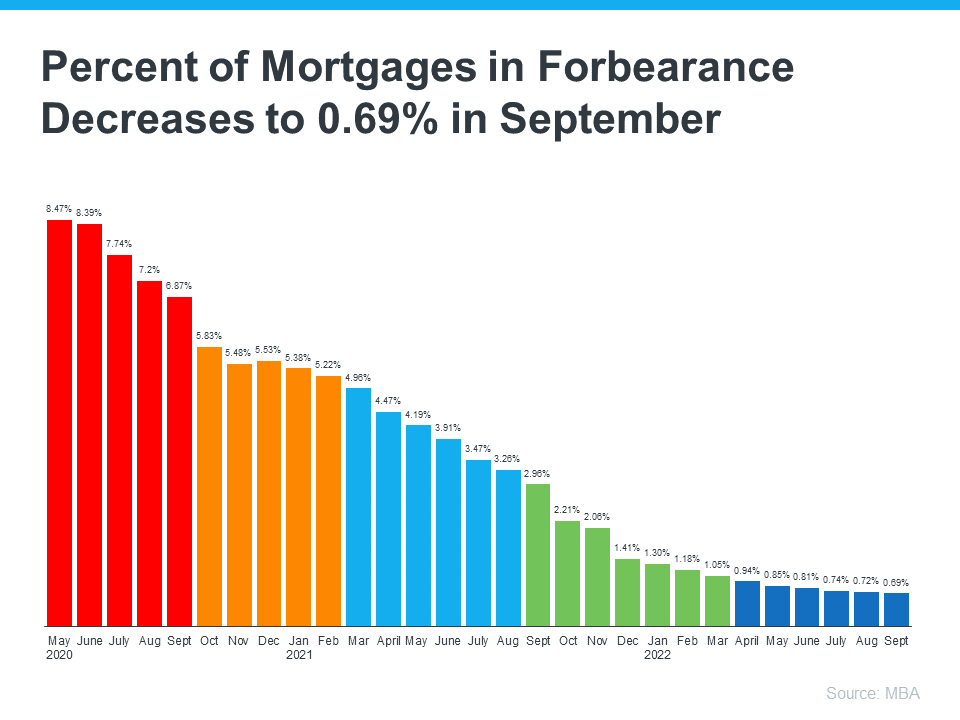
Data from the Mortgage Bankers Association (MBA) helps tell this story. It shows the overall percentage of homeowners at risk is decreasing significantly with time (see graph below):

Home Equity: A Source of Strength for Homeowners Today | MyKCMBut even though the volume of homeowners at risk is very low, there is still a small percentage of homeowners who may be coming face to face with foreclosure as a possibility today. If you're facing difficulties yourself, it can help to understand your options. It starts with knowing what foreclosure is. Investopedia defines it like this:

Typically, default is triggered when a borrower misses a specific number of monthly payments . . . Foreclosure is the legal process by which a lender attempts to recover the amount owed on a defaulted loan by taking ownership of and selling the mortgaged property.

The good news is there are alternatives available to help you avoid going through the foreclosure process, including:

  • Reinstatement
  • Loan modification
  • Deed-in-lieu of foreclosure
  • Short sale

But before you go down any of those paths, it's worth seeing if you have enough equity in your home to sell it and protect your investment.

You May Be Able To Use Your Equity To Sell Your House

Equity is the difference between what you owe on the home and its market value based on factors like price appreciation.

In today's real estate market, many homeowners have far more equity in their homes than they realize due to the home price appreciation we've seen over the past few years. According to CoreLogic:

The total average equity per borrower has now reached almost $300,000, the highest in the data series.

So, what does that mean for you? If you've lived in your house for at least a few years or more, chances are your home's value, and your equity, has risen dramatically. In addition, the mortgage payments you've made during that time chipped away at the balance of your loan. If your home's current value is higher than what you still owe on your loan, you may be able to use that increase to your advantage.

Rick Sharga, Executive VP of Market Intelligence at ATTOM Dataexplains how equity can help:

Very few of the properties entering the foreclosure process have reverted to the lender at the end of the foreclosure. . . We believe that this may be an indication that borrowers are leveraging their equity and selling their homes rather than risking the loss of their equity in a foreclosure auction.

Lean on Experts To Explore Your Options

To find out how much equity you have, work with a local real estate professional. They can give you an estimate of what your house could sell for based on recent sales of similar homes in your area. You may be able to sell your house to avoid foreclosure.

If you find out you have to pursue other options, your agent can help with that too. They'll be able to connect you with other professionals in the industry, like housing counselors, who can look into your unique situation and offer advice on next steps if selling isn't your best alternative.

Bottom Line

If you're a homeowner facing hardship, let's connect so you have an expert on your side to explore your options and see if you can sell your house to avoid foreclosure.


Posted in Market Updates
Nov. 11, 2022

VA Loans: Making Homes for the Brave Achievable [INFOGRAPHIC]?

VA Loans: Making Homes for the Brave Achievable [INFOGRAPHIC]

VA Loans: Making Homes for
the Brave Achievable [INFOGRAPHIC] | MyKCM

Some Highlights

  • VA Loans can help make homeownership possible for those who have served our country.
  • These loans offer great benefits for eligible individuals and can help them buy a VA-approved house or condo, build a new home, or make improvements to their house.
  • Homeownership is the American Dream. One way we can honor and thank our veterans is to ensure they have the best information about the benefits of VA home loans.
  •  
Posted in Market Updates
Nov. 1, 2022

3 Trends That Are Good News for Today's Homebuyers?

3 Trends That Are Good News for Today's Homebuyers

3 Trends That Are Good News
for Today's Homebuyers | MyKCM

While higher mortgage rates are creating affordability challenges for homebuyers this year, there is some good news for those people still looking to buy a home.

As the market has cooled this year, some of the intensity buyers faced during the peak frenzy of the pandemic has cooled too. Here are just a few trends that may benefit you when you go to buy a home today.

1. More Homes To Choose from

During the pandemic, housing supply hit a record low at the same time buyer demand skyrocketed. This combination made it difficult to find a home because there just weren't enough to meet buyer demand. According to Calculated Risk, the supply of homes for sale increased by 39.5% for the week ending October 28 compared to the same week last year.

Even though it's still a sellers' market and supply is still lower than more normal levels, you have more to choose from in your home search. That makes finding your dream home a bit less difficult.

2. Bidding Wars Have Eased

One of the top stories in real estate over the past two years was the intensity and frequency of bidding wars. But today, things are different. With more options, you'll likely see less competition from other buyers looking for homes. According to the National Association of Realtors (NAR), the average number of offers on recently sold homes has declined. This September, the average was 2.5 offers per sale. In contrast, last September, the average was 3.7 offers per sale.

If you tried to buy a house over the past two years, you probably experienced the bidding war frenzy firsthand and may have been outbid on several homes along the way. Now you have a chance to jump back into the market and enjoy searching for a home with less competition.

3. More Negotiation Power

And when you have less competition, you also have more negotiating power as a buyer. Over the last two years, more buyers were willing to skip important steps in the homebuying process, like the appraisal or inspection, to try to win a bidding war. But the latest data from the National Association of Realtors (NAR) shows the percentage of buyers waiving those contingencies is going down.

As a buyer, this is good news. The appraisal and the inspection give you important information about the value and condition of the home you're buying. And if something turns up in the inspection, you have more power today to renegotiate with the seller.

survey from realtor.com confirms more sellers are accepting offers that include contingencies today. According to that report, 95% of sellers said buyers requested a home inspection, and 67% negotiated with buyers on repairs as a result of the inspection findings.

Bottom Line

While buyers still face challenges today, they're not necessarily the same ones you may have been up against just a year or so ago. If you were outbid or had trouble finding a home in the past, now may be the moment you've been waiting for. Let's connect to start the homebuying process today.


Posted in Market Updates
Oct. 31, 2022

Taking the Fear out of Saving for a Home Taking the Fear out of Saving for a Home | MyKCM If you're planning to buy a home, knowing what to budget for and how to save may sound scary at first. But it

Taking the Fear out of Saving for a Home

Taking the Fear out of
Saving for a Home | MyKCM

If you're planning to buy a home, knowing what to budget for and how to save may sound scary at first. But it doesn't have to be. One way to take the fear out of budgeting is understanding some of the costs you might encounter. And to do that, turn to trusted real estate professionals. They can help you plan your finances and prepare your budget.

Here are just a few costs experts say you can expect.

1. Down Payment

Saving for your down payment is likely top of mind as you set out to buy a home. But do you know how much you'll need to save? While each situation is different, there's a common misconception that putting 20% down toward your purchase is required. An article from the Mortgage Reports explains why that's not always the case:

The idea that you have to put 20% down on a house is a myth. . . . The right amount depends on your current savings and your home buying goals.

To understand your options, partner with a trusted real estate professional to go over the various loan types, down payment assistance programs, and what each one requires.

2. Closing Costs

Make sure you also budget for closing costs, which are a collection of fees and payments made to the various people involved in your transaction. Bankrate explains:

Closing costs are the fees you pay when finalizing a real estate transaction, whether you're refinancing a mortgage or buying a new home. These costs can amount to 2 to 5 percent of the mortgage so it's important to be financially prepared for this expense.

The best way to understand what you'll need at the closing table is to work with a trusted lender. They can provide you with answers to the questions you might have.

3. Earnest Money Deposit

If you want to cover all your bases, you can also consider saving for an earnest money deposit (EMD). An EMD is money you pay as a show of good faith when you make an offer on a house. According to realtor.com, it's usually between 1% and 2% of the total home price.

This deposit works like a credit. It's not an added expense – it's paying a portion of your costs upfront. You're using some of the money you already saved for your purchase to show the seller you're committed and serious about their house. Realtor.com describes how it works as part of your sale:

It tells the real estate seller you're in earnest as a buyer, . . . . Assuming that all goes well and the buyer's good-faith offer is accepted by the seller, the earnest money funds go toward the down payment and closing costs. In effect, earnest money is just paying more of the down payment and closing costs upfront.

Keep in mind, an EMD isn't required, and it doesn't guarantee your offer will be accepted. It's important to work with a real estate advisor to understand what's best for your situation and any specific requirements in your area. They'll help you determine what moves you should make in the homebuying process to have the greatest success.

Bottom Line

Budgeting for your home purchase doesn't have to be scary. Let's connect so you'll have an expert on your side to answer any questions you have along the way.


Posted in Market Updates
Oct. 28, 2022

Applying for a Mortgage Doesn't Have To Be Scary [INFOGRAPHIC]?

Applying for a Mortgage Doesn't Have To Be Scary [INFOGRAPHIC]

Applying for a Mortgage
Doesn't Have To Be Scary [INFOGRAPHIC] | MyKCM

Some Highlights

  • Even with higher mortgage rates, the mortgage process doesn't need to be something you fear. Here are some steps to help as you set out to buy a home.
  • Know your credit score and work to build strong credit. When you're ready, lean on the pros and connect with a lender so you can get pre-approved and begin your home search.
  • Any major life change can be scary, and buying a home is no different. Let's connect so you have an advisor by your side to take fear out of the equation.
  •  
Posted in Market Updates
Oct. 26, 2022

3 Graphs Showing Why Today's Housing Market Isn't Like 2008?

3 Graphs Showing Why Today's Housing Market Isn't Like 2008

3 Graphs Showing Why
Today's Housing Market Isn't Like 2008 | MyKCM

With all the headlines and talk in the media about the shift in the housing market, you might be thinking this is a housing bubble. It's only natural for those thoughts to creep in that make you think it could be a repeat of what took place in 2008. But the good news is, there's concrete data to show why this is nothing like the last time.

There's Still a Shortage of Homes on the Market Today, Not a Surplus

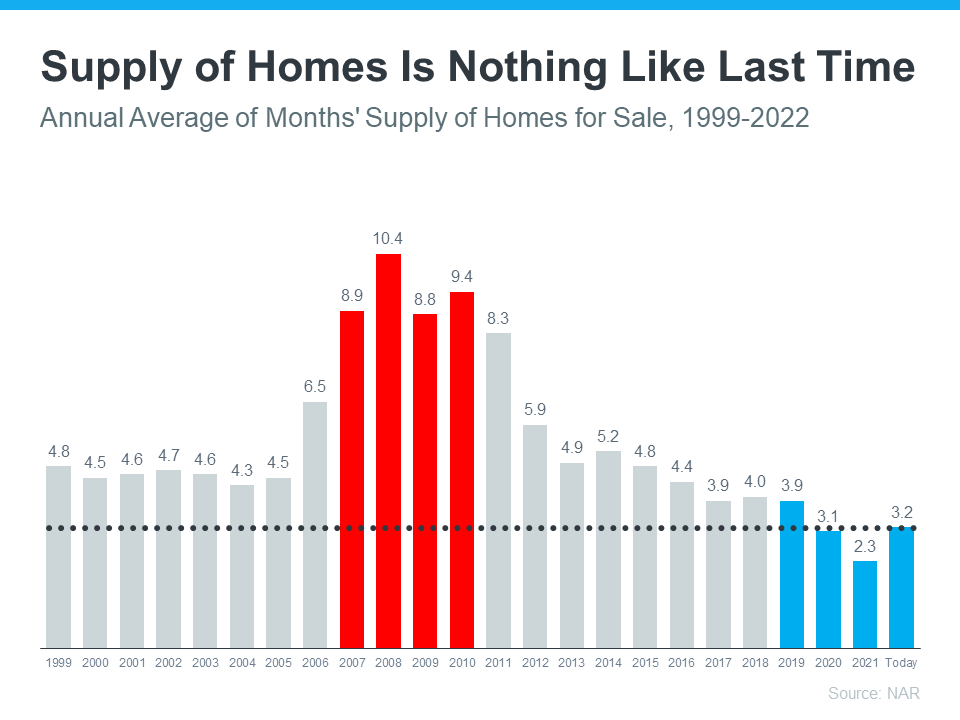
For historical context, there were too many homes for sale during the housing crisis (many of which were short sales and foreclosures), and that caused prices to fall dramatically. Supply has increased since the start of this year, but there's still a shortage of inventory available overall, primarily due to almost 15 years of underbuilding homes.

The graph below uses data from the National Association of Realtors (NAR) to show how the months' supply of homes available now compares to the crash. Today, unsold inventory sits at just a 3.2-months' supply at the current sales pace, which is significantly lower than the last time. There just isn't enough inventory on the market for home prices to come crashing down like they did last time, even though some overheated markets may experience slight declines.

3 Graphs Showing Why Today's Housing Market Isn't Like 2008 | MyKCM

Mortgage Standards Were Much More Relaxed Back Then

During the lead-up to the housing crisis, it was much easier to get a home loan than it is today. Running up to 2006, banks were creating artificial demand by lowering lending standards and making it easy for just about anyone to qualify for a home loan or refinance their current home.

Back then, lending institutions took on much greater risk in both the person and the mortgage products offered. That led to mass defaults, foreclosures, and falling prices. Today, things are different, and purchasers face much higher standards from mortgage companies.

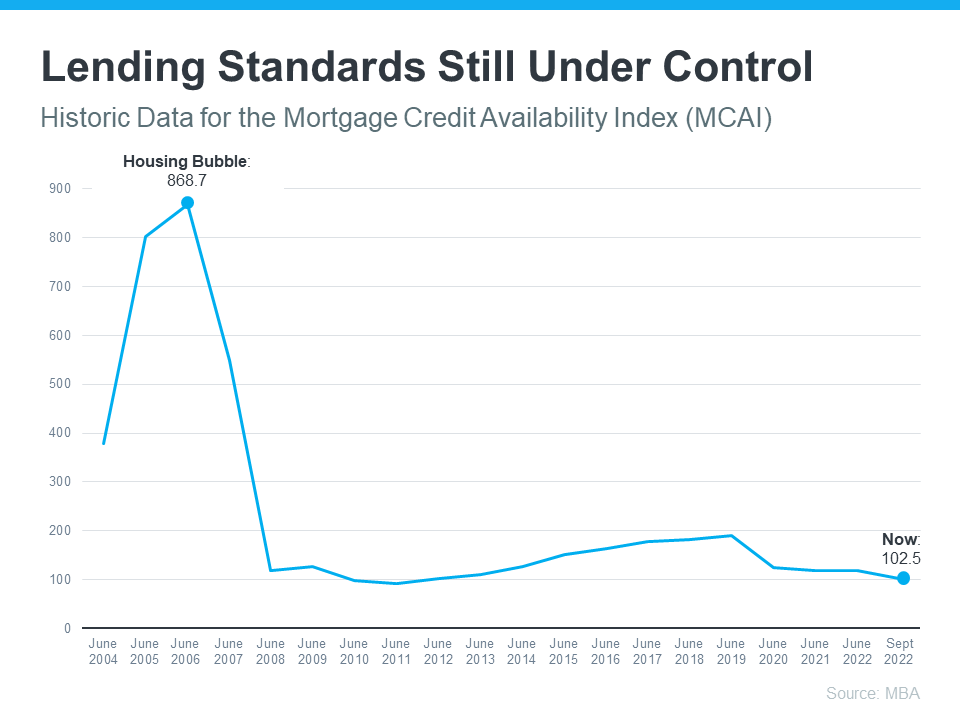
The graph below uses Mortgage Credit Availability Index (MCAI) data from the Mortgage Bankers Association (MBA) to help tell this story. In that index, the higher the number, the easier it is to get a mortgage. The lower the number, the harder it is. In the latest report, the index fell by 5.4%, indicating standards are tightening.

3 Graphs Showing Why Today's Housing Market Isn't Like 2008 | MyKCM

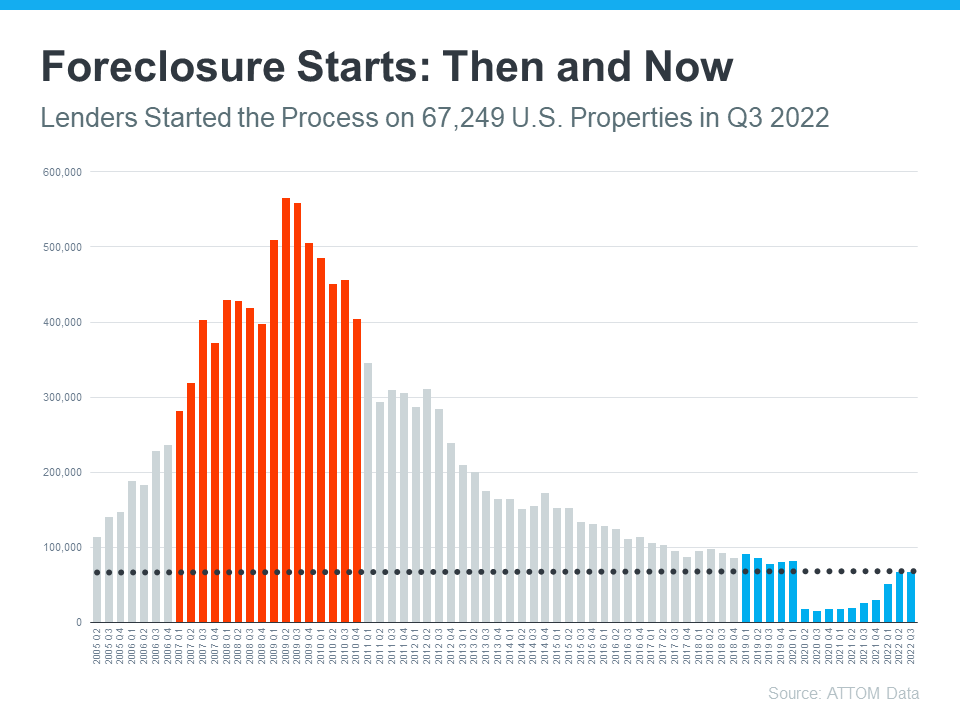
This graph also shows just how different things are today compared to the spike in credit availability leading up to the crash. Tighter lending standards over the past 14 years have helped prevent a scenario that would lead to a wave of foreclosures like the last time.

The Foreclosure Volume Is Nothing Like It Was During the Crash

Another difference is the number of homeowners that were facing foreclosure after the housing bubble burst. Foreclosure activity has been lower since the crash, largely because buyers today are more qualified and less likely to default on their loans. The graph below uses data from ATTOM Data Solutions to help paint the picture of how different things are this time:

3 Graphs Showing Why Today's Housing Market Isn't Like 2008 | MyKCM

Not to mention, homeowners today have options they just didn't have in the housing crisis when so many people owed more on their mortgages than their homes were worth. Today, many homeowners are equity rich. That equity comes, in large part, from the way home prices have appreciated over time. According to CoreLogic:

The total average equity per borrower has now reached almost $300,000, the highest in the data series.

Rick Sharga, Executive VP of Market Intelligence at ATTOM Dataexplains the impact this has:

Very few of the properties entering the foreclosure process have reverted to the lender at the end of the foreclosure. . . . We believe that this may be an indication that borrowers are leveraging their equity and selling their homes rather than risking the loss of their equity in a foreclosure auction.

This goes to show homeowners are in a completely different position this time. For those facing challenges today, many have the option to use their equity to sell their house and avoid the foreclosure process.

Bottom Line

If you're concerned we're making the same mistakes that led to the housing crash, the graphs above should help alleviate your fears. Concrete data and expert insights clearly show why this is nothing like the last time.


Posted in Market Updates